Chicano and Latin American Studies
Faculty
The Chicano and Latin American Studies Department consists of faculty whose teaching and research expertise cover a broad spectrum, including anthropology, education, history, sociology, political science, Latin America, Latino literature, and the arts.
Full Time Faculty:

Telephone: 559.278.8808
Email: mlopes@mail.fresnostate.edu
Office: SS 216
Student Support Hours: Tuesday and Thursday 1:00p.m. to 2:30p.m., schedule a Zoom
meeting via the link: https://calendly.com/mlopesfresnostate/new-meeting
Education:
Ph.D. in History, El Colegio de México (Mexico City, Mexico, 1996-1999), Dissertation: "Abigeos, bandidos sociales y 'malhechores facciosos'. Criminalidad y justicia en el estado de Chihuahua. 1876-1920," (Cattle Rustlers and Social Bandits: Criminality and Justice in the State of Chihuahua, Mexico, 1876-1920) 1999. Committee: Profs. Romana Falcón (Chair), Javier Garciadiego, Luis Aboites, and Leticia Mayer.
Research Interests:
For more than five years, Dr. Maria-Aparecida Lopes has been studying commercial relations between Mexico and the United States focusing on the livestock exchanges, from the late nineteenth century to the 1950s. Her article "Revolution and Livestock Economy in Northern Mexico" (Revolución y ganadería en el norte de México) published in 2008 by Historia Mexicana, won Honorable Mention for the category Twentieth Century Mexican History awarded by Mexican Committee of Historical Sciences (Comité Mexicano de Ciencias Históricas), Mexico, July 7, 2010.
Apart from her research on Mexico-U.S. relations, she has also published articles on the following topics: a comparison between the Brazilian and the Mexican independence movements; socioeconomic aspects of the development of the cattle industry in Mexico and Brazil; the creation and evolution of urban centers in South America; and the Brazilian land laws in the nineteenth century.
Publications or Papers:
Rio de Janeiro in theGlobal Meat Market, c. 1850 to c. 1930. How Fresh and Salted Meat Arrived at the Carioca Table. New York: Routledge, 2021.
“Institutions and Interest Groups: Meat Provision in Mexico City, C. 1850–1967,” co-author Reynaldo de los Reyes Patiño, Mundo Agrario 21, no. 46 (2020).
2017. “Escasez, epizootia y experimentos sindicales. El abasto de carne en la capital federal mexicana, 1929-1955,” (Scarcity, Epizootics and Unionism. The Supply of Meat in the Mexican Federal Capital, 1929-1955), in: Enriqueta Quiroz,Integración y desintegración del espacio económico mexicano: mercado interno y abastecimiento de las carnes desde la colonia al siglo XX, México: Instituto de Investigaciones Dr. José María Luis Mora, Consejo Nacional de Ciencia y Tecnología, pp. 295-330.
2016. Mercados en Común. Estudios sobre conexiones transnacionales, negocios y diplomacia en las Américas (siglos XIX y XX), (Markets in Common. Studies in Transnational Connections, Business, and Diplomacy in the Americas, Nineteenth and Twentieth Centuries), co-editor María Cecilia Zuleta, México, El Colegio de México, 647 pp.
2016. “Carne para ‘las masas hambrientas.’ Interconexiones del comercio de ganado vacuno en el Atlántico Norte, 1884-1914,” (Meat for ‘the Hungry Masses’, Cattle Trade in the North Atlantic, 1884-1914), in: Maria-Aparecida Lopes and María Cecilia Zuleta (editors), Mercados en Común. Estudios sobre Conexiones transnacionales, Negocios y Diplomacia en las Américas (siglos XIX y XX), México: El Colegio de México.
2015. “Struggles over an ‘Old, Nasty, and Inconvenient Monopoly’: Municipal Slaughterhouses and the Meat Industry in Rio de Janeiro, 1880-1920s”, Journal of Latin American Studies, vol. 47:2, pp. 349-376.
2012. "Borders, Trade, and Politics: Exchange between the United States and Mexican Cattle Industries, 1870-1947”, in collaboration with Paolo Riguzzi, Hispanic American Historical Review, Vol. 92:4, pp. 603-635.
2011. Consumo e abastecimento na história, Maria-Aparecida Lopes, Margarida Maria de Carvalho, and Denise Aparecida Soares Moura (editors), São Paulo: Editora Alameda.
2011. "'Que se cumplan los sagrados principios de la revolución': cambio y continuidad en la política de abasto de la carne en la ciudad de México," Mexico: Historia Mexicana, Vol. 60:4 April-June, pp. 2111-2155.
2005. De costumbres y leyes. Abigeato y derechos de propiedad en Chihuahua durante el porfiriato, Mexico: El Colegio de México/El Colegio de Michoacán.
Teaching Interests:
For the last five years, Professor Dr. Maria-Aparecida Lopes has been a faculty member in the Chicano and Latin American Studies and History Departments at California State University, Fresno, where she has been teaching a variety of undergraduate and graduate courses on Latin American history. She commenced her career in education as a high school teacher in the São Paulo public school system (Brazil). After finishing her PhD in Mexico, Dr. Lopes was a professor of U.S. and Latin American history at the State University of São Paulo for five years. She also taught a graduate course on Brazilian Historiography at Metropolitan Autonomous University, Mexico.
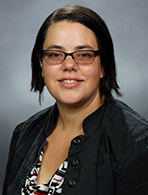 Telephone: 559.278.3020
Email: aespanajera@mail.fresnostate.edu
Office: SS 226B
Student Support Hours: TBA
Education:
Ph.D. and M.A. (Political Science) from the University of Notre Dame, Notre Dame, IN.
B.A. from the University of British Columbia, Vancouver, Canada.
Research Interests:
Dr. España-Nájera research interests are focused on contemporary political issues in Latin America. She is concerned with studying regimes and the challenges to consolidating and fortifying democracies in the region. Her research has focused on institution and institutionalization, especially in terms of party systems and political parties. She has analyzed what factors shape these institutions and what impact they in turn have on the quality of democracy in Latin America. Currently, her research interests have also sought to analyze the state in Central America, exploring the development of weak states and their consequences for questions of democracy and security in the region.
Dr. España-Nájera is also an active member of the World Cultures & Globalization Cohort at Fresno State University.
Publications or Papers:
"Polarización en América Latina, comparando sistemas de partidos politicos e individuos a través del tiempo" Boletines Proyecto de Élites Parlamentarias Latinoamericanas"The Vote Share of New and Young Parties" (with Scott Mainwaring and Carlos Gervasoni), Kellogg Institute Working Paper Series, #368, University of Notre Dame, July 2010"Surveying the Field: Basic Graduate Training in Comparative Politics" (with Xavier Márquez and Paul Vasquez), APSA-CP Newsletter, 14:1: 28-34, Winter 2003.
Teaching Interests:
Dr. España-Nájera's teaching interests include contemporary issues in Latin America, in particular in how they relate to questions of regime and regime change, inequality and development, and institutions and institutionalization. Her classes adopt a comperative perspective, which use comparisons of countries or regions to gain a more in-depth understanding of processes of development and change.
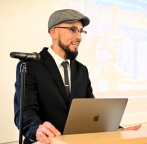 Telephone: 559.278.1095
Email: luisfernando@mail.fresnostate.edu
Office: SS 222
Student Support Hours: Tuesday and Thursday, 10:15a.m. to 10:45a.m., 1:15p.m. to1:45
p.m. or by appointment. Book via https://calendar.app.google/sKx6TJAjeRGo3Bxx8
Education:
Ph.D. Multicultural and Equity Studies in Education, The Ohio State University
M.A. Cross Cultural and International Education, Bowling Green State University
B.A. Spanish/Translation, University of Texas at El Paso
Publications or Papers:
Macías, L. F. (2022). Hall Pass: DACA recipients’ experiences “passing” in higher education. Equity & Excellence in Education, 55(1-2), 87-104.
Collet, B. A., & Macías, L. F. (2022). Sacred mobilisations: sanctuary churches and sanctuary schools. Compare: A Journal of Comparative and International Education, 52(6), 1015-1032.
Macías, L. F. (2018). The scheme game: How DACA recipients navigate barriers to higher education. Educational Studies, 54(6), 609-628.
Macías, L.F., Collet, B. (2016). Separated By Removal: Impact of parental deportation on U.S citizen children's educational goals. Diaspora, Indigenous, and Minority Education, 10(3), 169-181.
Teaching Interests:
Immigrant Education
Social Justice Education
Critical Multiculturalism
Latina/o/x Studies
Race and Ethnicity
Undocumented Studies
Immigration Studies
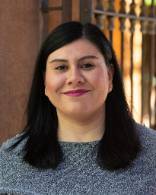 Telephone: 559.278.0086
Email: alinamendez@mail.fresnostate.edu
Office: SS 215
Student Support Hours: TBA
Education
Ph.D. in History, University of California, San Diego
M.A. in History, University of California, San Diego
B.A. in History, University of California, Berkeley
Research Interests
Dr. Méndez's main research interests are migration, labor, and the US-Mexico borderlands. Her doctoral dissertation, titled “Cheap for Whom? Migration, Farm Labor, and Social Reproduction in the Imperial Valley-Mexicali Borderlands, 1942-1969,” won the 2018 Chancellor’s Dissertation Award in the Division of Arts and Humanities at the University of California, San Diego, and the 2019 Herbert G. Gutman Prize for Outstanding Dissertation from the Labor and Working-Class History Association.
Publications or Papers
Méndez, Alina R. “Gendered Invisibility: Ethnic Mexican Women and the Bracero Program.” Women and Social Movements in the United States, 1600-2000 25 no. 2 (September 2021).
Méndez, Alina R. “More Than Victims or Villains: Representations of Mexican Migrant Men in the Imperial Valley-Mexicali Borderlands, 1942-1954.” California History 98 no. 3 (2021): 28-53.
Teaching Interests
Dr. Méndez's teaching interests include Chicanx/Latinx culture and history, labor and migration, the US-Mexico borderlands, and relational racial formation.
Telephone: 559.278.2239
Email: ramons@mail.fresnostate.edu
Office: SS 227
Student Support Hours: Monday 12:00 p.m. to 1:00 p.m., Wednesday 11:00 a.m.to 1:00
p.m., Tuesday and Thursday 3:45 p.m. to 4:45 p.m.
Education:
The University of New Mexico, Ph.D. American Studies
Bowling Green State University, M.F.A. Creative Writing
The University of Texas at El Paso, B.A. English
Research Interests:
Cross-cultural Latin American and U.S. Latina/o ethnic studies and literature with a historical emphasis.
 Telephone: 559.278.4115
Email: victort@mail.fresnostate.edu
Office: SS 220
Student Support Hours: Tuesday and Thursday 1:00pm to 1:50pm; Monday and Wednesday
12:00pm to 1:00pm, or by appointment via email or Zoom
Education:
UC Irvine, Ph.D. Anthropology
Interests:
Dr. Victor Torres, Ph.D., is an anthropologist and Full Professor in the Department of Chicano and Latin American Studies at California State University, Fresno. His passion for Mexican folkloric dance began and flourished at UC Irvine, where he danced and directed throughout his B.A. and Ph.D. studies. After completing his studies at UCI, he was recruited to Fresno State by highly esteemed Prof. Ernesto Martinez. Prof. Martinez recruited Dr. Torres to succeed him as Director of Los Danzantes de Aztlán, the Mexican dance program he founded in the department of Chicano and Latin American Studies.
Los Danzantes de Aztlán is the only Mexican folkloric dance troupe in the CSU system to be recognized as an official ambassador of the University. This status was recently reaffirmed in 2013 by former President John Welty. Los Danzantes de Aztlán is a highly respected Mexican dance troupe in California, in the Southwest, and in Mexico. Under Dr. Torres’ tutelage, the troupe has earned top honors in international and national competitions. The success and professionalism of the troupe under his direction has resulted in the troupe being considered an “associate” group of the Ballet Folclorico Nacional de Mexico de Silvia Lozano (BFNM). More recently, the troupe was selected to perform in the prestigious San Francisco Ethnic Dance Festival – the largest ethnic dance festival in the nation, which runs for the entire month of June.
Dr. Torres served on the Board of Directors of the Associación Nacional de Grupos Folklóricos (ANGF) for 6 years (1997-2003), two of them as Vice-President. He is also the founder of the annual “Festival de Los Danzantes” folklórico conference at Fresno State, as well as the founder of the annual “Cal State Folklórico Show (which features various California State University groups). Dr. Torres also serves on the Danzantes del Valle Advisory Committee for Arte Americas –Fresno’s major Latino cultural center.
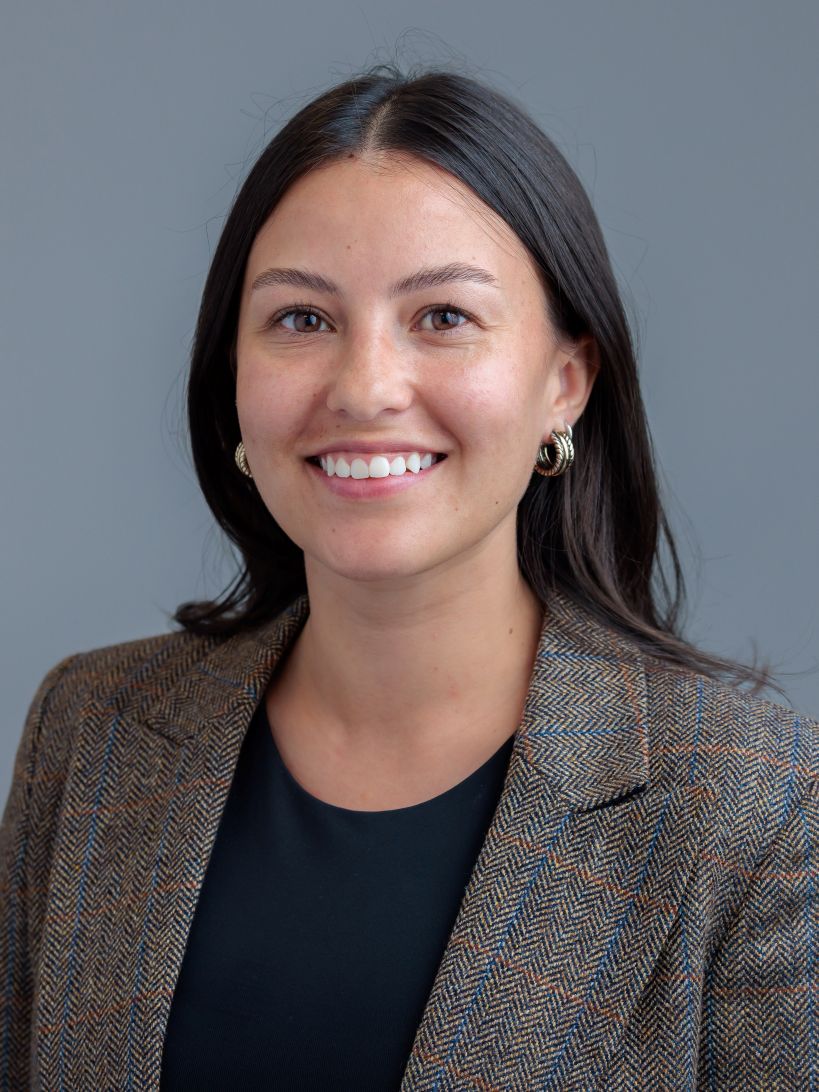 Telephone:559.278.3021
Email: jvivasbastidas@mail.fresnostate.edu
Office: SS209A
Student Support Hours: TBA
Education:
PhD Sociology, Loyola University Chicago
Dissertation - Making Sense of the Barrio: Place-based Appraisals and Coping Among
Latine Residents in ChicagoCo-Chairs: Dr. Dana Garbarski and Dr. Maria Akchurin; Readers:
Dr. Jason L. Cummings and Dr. Teresa I. Gonzales
Special Fields - Race and Ethnicity; Gender, Sex, and Sexuality
MA Sociology, Loyola University Chicago
Thesis - Migration Across Institutions of Race: How Immigrant Women from Latin America
Construct Ethnoracial Self-Identities in Sending and Receiving Societies
Chair: Dr. Dana Garbarski; Reader: Dr. Maria Akchurin
BA Sociology, Loras College
Thesis - Tautological Nature of Racism: Analyzing the Role of Written Media in Perpetuating
Anti-Black Police Brutality
Chair: Dr. Lisa Garoutte; Reader: Dr. Kathrin Parks
Research Intersts:
Dr. Juanita Vivas Bastidas is an environmental and urban sociologist who studies how systems of power shape experiences of migration, environmental inequality, and mental health. Dr. Vivas Bastidas uses both qualitative and quantitative methods, selecting approaches best suited to the research question at hand, including ethnography, interviews, photo-elicitation, logistic regression, and GIS mapping. Dr. Vivas Bastidas’s most recent work examines how people interpret and respond to social and environmental stressors in Chicago’s Latine barrios, drawing on Black, Chicana, and Standpoint feminist methodologies. As a community-engaged scholar and member of the Chicago Coalition to End Sacrifice Zones, Dr. Vivas Bastidas consistently collaborates with Latine-led environmental justice organizations to understand how people experience and make sense of their exposure to environmental harm, and how they organize toward environmental justice. Dr. Vivas Bastidas, along with Dr. Maria Akchurin at Loyola University Chicago and Neighbors for Environmental Justice, has been awarded one of the 2026 American Sociological Association’s Community Action Research Initiative grants. Together, they are exploring how three often underrepresented groups of residents on Chicago’s Southwest Side — namely, older adults, workers in industry or retraining for green jobs, and small business owners — prioritize environmental concerns relative to other issues. Dr. Vivas Bastidas has presented her work at major conferences, including the American Sociological Association, the Latinx Studies Association, the American Association for Public Opinion Research, and the Chicago Ethnography Conference. Her work has been published in The Sociological Quarterly, Survey Practice, and Contexts.
Publications or Papers
Akchurin, Maria and Juanita Vivas Bastidas. 2025. “Beyond Sacrifice Zones: Rethinking
Pollution Through a Cumulative Impact Lens.” Contexts 24(2): 28-33.
McRoy, Martha, and Juanita Vivas Bastidas. 2025. “Comparing Techniques to Identify
Spanish-Speaking Households.” Survey Practice 19(S1):1–10.
Reprinted in Cross-Cultural Research in Practice, edited by Mandy Sha and Eva Aizpurua
(2026).
Vivas Bastidas, Juanita, Maria Akchurin, Dana Garbarski, and David Doherty. 2024. “How Local Perceptions Contribute to Urban Environmental Activism: Evidence from the Chicago Metropolitan Area.” The Sociological Quarterly 65(1):38-60.
Teaching Interests
As a professor, Dr. Juanita Vivas Bastidas is committed to inclusive, equity-minded, and student-centered pedagogy that empowers students to connect sociological theory to everyday life and to become responsible members of society prepared to engage in positive social change. Her goals as an educator are to: (1) center marginal standpoints in her syllabi; (2) foster curiosity through experiential learning methods—including music, games, and interactive demonstrations; (3) build respectful, participatory communities of inquiry; and (4) provide opportunities for professional development by inviting undergraduate and graduate students to collaborate on research projects that equip them with the tools and methods to contribute thoughtfully and effectively in their future careers and communities. At Loyola University Chicago, Dr. Vivas Bastidas taught and guest lectured in courses including Self and Society, Sociology of the African American Experience, Environmental Sociology, Environmental Justice, City, Suburbs & Beyond, and Sociology of Health and Medicine. At Fresno State, Dr. Vivas Bastidas teaches CLAS 5: Chicano Culture and CLAS 120: Latina/o Cultural Changes. Dr. Vivas Bastidas is also interested in teaching research methods and a course on the Environmental Justice Movement in the Americas, comparing and contrasting the experiences of environmental risk and activist organizing across North, Central, and South America.
FERP Faculty:
| Name | Contact | Student Support Hours |
|---|---|---|
| Dr. Carlos Perez | Telephone: 559.278.6506 Email: cperez@mail.fresnostate.edu Office: SS 129 |
TBA |
Part-Time Faculty:
| Name | Contact | Student Support Hours |
|---|---|---|
| Dr. George Fontes | Telephone: 559.278.6506 Email: patrickfontes@mail.fresnostate.edu Office: SS 129 |
Monday, Wednesday, Friday 10:00a.m. to1:30p.m. or by appointment |
| Dr. Matthew Ford | Telephone: 559.278.2848 Email: mford02@mail.fresnostate.edu Office: IT 262 |
TBA |
| Veronica Leal |
Telephone: 559.278.6506 |
TBA |
| Dr. Marie Lerma |
Telephone: 559.278.2848 |
TBA |
| Dr. Noé López | Telephone: 559.278.6506 Email: noelopez@mail.fresnostate.edu Office: SS 129 |
TBA |
| Dr. Elvia Rodriguez |
Telephone: 559.278.2848 Email: elviarodriguez@mail.fresnostate.edu Office: NG 141E |
By Appointment |
Department Staff
| Name | Contact | Administrative Hours |
|---|---|---|
| Laura Ibarra Pimentel Administrative Support Coordinator I |
Telephone: 559.278.0418 |
8:00a.m. to 5:00p.m. Closed for lunch 12:00p.m.-1:00p.m. |