Africana Studies Program
Welcome to Africana Studies
What does it mean to understand the world from Africa—and from the many worlds Africa has helped to create?
Welcome to Africana Studies at Fresno State.
Africana Studies begins with a simple but profound recognition: Africa and its diasporas are not peripheral to the human story. They are among its great centers of memory, creativity, struggle, thought, and transformation. To study Africana worlds is therefore not to turn away from humanity’s larger questions, but to enter them through histories and traditions that have too often been fragmented, marginalized, or misunderstood.
Africana Studies is grounded in the experiences of African and African-descended peoples, but its intellectual reach is universal. It asks how power operates, how identities are formed, how communities preserve memory, how cultures survive displacement, and how people continue to imagine freedom under difficult conditions. It examines race and racism, but it also examines philosophy, politics, literature, economics, religion, gender, migration, art, music, science, education, and the possibilities of human belonging.
This is what makes Africana Studies profoundly interdisciplinary. It does not confine students to a single method or profession. Rather, it teaches them to move thoughtfully among disciplines, to recognize connections that conventional boundaries may conceal, and to bring historical understanding into conversation with the problems of the present.
Africana Studies can therefore speak to the future lawyer concerned with justice, the physician attentive to health disparities, the educator seeking to understand diverse classrooms, the entrepreneur working in a global economy, the artist exploring memory and identity, the public servant shaping policy, and the scientist or technologist confronting the human consequences of innovation. Whatever your field, Africana Studies can deepen the questions you ask and enlarge the world within which you seek answers.
At the heart of our program is the understanding of history as re-membership. History does more than record what happened. It gathers what has been scattered, restores relationships that have been severed, and returns individuals and communities to stories from which they have been excluded. To remember in this deeper sense is to re-member: to bring the fragmented parts of our shared humanity into meaningful relation again.
Our students are invited to become participants in this work. They learn not simply to receive knowledge, but to question it, interpret it, and contribute to its creation. They encounter Africa and the African diaspora not only as objects of study, but as intellectual worlds that have generated enduring ideas about personhood, community, beauty, justice, resistance, and human flourishing.
At Fresno State, students may pursue the 33-unit B.A. in Africana Studies, add an 18-unit Africana Studies double major, or develop focused knowledge through our 12-unit joint certificates in Racial Understanding, Black Culture and Racial Justice, and Africana Historical Experience. These pathways are designed to make Africana Studies accessible to students across the university.
Our location in the Central Valley gives this work particular urgency. Fresno is shaped by extraordinary cultural diversity, migration, agricultural labor, inequality, resilience, and community creativity. Africana Studies offers an intellectual home from which students can connect global histories with local realities and translate scholarship into meaningful public engagement.
I invite you to explore our courses, meet our faculty, attend our events, and discover the many directions in which Africana Studies can take you. More importantly, I invite you to bring your own questions, experiences, and aspirations into our community.
You are welcome here—not simply as a student entering a program, but as a participant in an ongoing intellectual tradition and a contributor to the worlds we have yet to create.
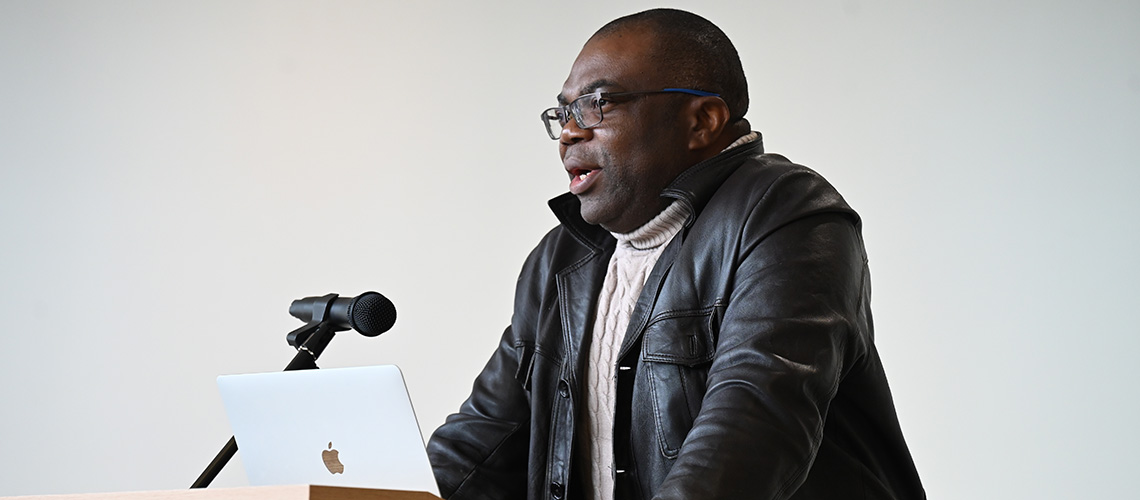
Michael Onyebuchi Eze, Ph.D., Dr.phil.
Associate Professor and Chair/Program Coordinator
Africana Studies
California State University, Fresno