Political Science
Administrator / Educator Influence on the Transition of Students, with Idea Services, from K-12 to Postsecondary/College during the COVID-19 Pandemic
ABSTRACT
The transition for students with Individualized Education Plans (IEPs) from K-12 to
postsecondary education, specifically college, is a challenging one. The support they
receive with an IEP in K-12 is structured with requirements in place that guide them
through the completion of their K-12 experience. Once they transition out of K-12,
those supports that were mandated are altered widely. Did the political framework
of the administrator/educator affect the transition of students with Individuals
with Disabilities Education Act (IDEA) services from K-12 to post-secondary/college
during the COVID 19 pandemic? Examining this transition across multiple districts
and administrators in California’s Central Valley, this thesis provides first-hand
insight and an understanding of the process, along with recommendations, on how to
support students as they are being advised to meet their educational goals or needs.
With the COVID-19 pandemic it is uncertain whether this will be a factor in the outcomes.
Laura L. Clark
December 2021
THESIS
by Laura L. Clark
A thesis submitted in partial fulfillment of the requirements for the degree of Master
of Arts Public Administration in the College of Social Sciences, California State
University, Fresno
December 2021
APPROVED
For the Department of Political Science:
We, the undersigned, certify that the thesis of the following student meets the required standards of scholarship, format, and style of the university and the student's graduate degree program for the awarding of the master's degree.
Laura L. Clark
Thesis Author
Lisa Bryant (Chair) Political Science
Colleen Torgerson Literacy, Early, Bilingual and Special Education
Kurt Cline Political Science
Kenneth Hansen Political Science
For the University Graduate Committee:
Dean, Division of Graduate Studies
AUTHORIZATION FOR REPRODUCTION OF MASTER’S THESIS
X I grant permission for the reproduction of this thesis in part or in its entirety without further authorization from me, on the condition that the person or agency requesting reproduction absorbs the cost and provides proper acknowledgment of authorship.
Permission to reproduce this thesis in part or in its entirety must be obtained from me.
Signature of thesis author:
ACKNOWLEDGMENTS
I would like to thank those who contributed to the completion of my thesis. First and foremost, to my committee for allowing me to pursue a topic that is near and dear to my heart. Their unwavering advice, time, and expertise both in the classroom and beyond made it possible for me to take on this endeavor. Dr. Cline and Dr. Hansen, for inspiring me with your instruction and encouragement. Dr. Bryant, my thesis chair, you helped me to persevere and to continue this adventure even during your sabbatical. Thank you for pushing me to find the right words to express what we both know I really wanted to get across. Dr. Torgerson, my subject matter expert, whose unparalleled dedication kept me on track even when I wanted to take a different path. To both Cheryl McDonald and Dr. Mahoney for providing the opportunity for my participation in the Kremen School of Education and Human Development’s special education classes. This perspective and interaction offered a wonderful insight into the behind-the-scenes world of the special education teacher training. To all the dedicated professionals who took the time to participate in the survey for this thesis, your time and genuine interest made this study possible. Dr. Emerzian, Kathy Wage, Karri Hammerstrom, Jennie Johnson and Jennifer Sullivan your input, insight and expertise were exceptional on this journey.
To Ronald, Debra, Caleigh, Rosie, and Chuck at the Fresno State Graduate Student Success Center your patience, kindness, and dedication to me and this endeavor was unparalleled.
To Juli, for the countless hours that we spent wordsmithing.
To my colleagues at Fresno State including Dean Yerrick, Paula, Caty, Micheline, Dr. Barker and Heather, your steadfast support is greatly appreciated.
To fellow MPA graduate David Santos-Garcia, you never gave up on me and continued to stand next to me throughout this entire process.
To the women of the Rotary Club of Fresno as well as Victoria, Sandra, Patty, Elizabeth and Metra, your continued conversations and moral support were just what I needed when I was sure that I could not spend one more hour on this project.
To my surrogate parents, George and Nancy; George, may you rest in peace and, Nancy, thank you for believing in me. To Carolyn and Betty, not only for your support, but also for connecting me with Kerri whose brilliant mind sees numbers and statistics as the grandest of adventures!
To Erin, for your continued cheery nature and unwavering roomie friendship.
Jill, I remember when we had the discussion about graduate school and how we were going to change our trajectory in life. We did it my dear friend! Finally, to my family, you are the wind beneath my wings. To my puppies Polly, Abbie, and Zara. Polly, may you rest in peace. Abbie, thank you for sitting with me day in and day out while I write, and to Zara who keeps me laughing. To my sister, your continual phone calls of encouragement and support really made a difference. To Aaron, you are the inspiration for this study. Your bravery and determination compelled me to try to help other students reach for their dreams. To Adam, Xuemei and Emilie, you not only encouraged and taught me how to go back to school but had faith that I could do this. And to my husband Larry, you stood right next to me, proofread, and held my hand, not only as we survived the pandemic, but every step of the way throughout this process.
TABLE OF CONTENTS
LIST OF TABLES viii
LIST OF FIGURES ix
CHAPTER 1: INTRODUCTION
- Purpose of the Study
Research Questions
Hypothesis
Context of the Study
Significance of the Study
CHAPTER 2: LITERATURE REVIEW
- Theoretical Framework
Bureaucratic Management Theory
Human Relations Management Theory
Disability Law
Americans with Disabilities Act (ADA)
Transition Services
COVID-19
CHAPTER 3: METHODOLOGY
- Study Design
Sample
Data Collection
Data Analysis
CHAPTER 4: RESULTS/OUTCOMES
- Quantitative Analysis
Qualitative Analysis
CHAPTER 5: DISCUSSION/SUMMARY/CONCLUSION
- Discussion of Findings
Limitations
Recommendations and Suggestions for Future Research
REFERENCES
APPENDICES
APPENDIX A: CONGRESSIONAL RESEARCH SERVICES TABLE 1. ID EA, SECTION 504, AND ADA:
SUMMARY AND COMPARISON OF SELECTED PROVISIONS
APPENDIX B: SURVEY INTERVIEW QUESTIONS
APPENDIX C: SURVEY INSTITUTIONS AND EMAIL INVITATION
APPENDIX D: SURVEY IRB APPROVAL AND CONSENT FORM
APPENDIX E: STATA OUTPUT
LIST OF TABLES
- Table 1 Management Type by Variable – K-12
- Table 2 Management Type by Variable - PS
- Table 3a K-12 Likert Questions
- Table 3b Postsecondary Likert Questions
- Table 4 Frequencies for Predictors of Postsecondary Success by Institution Type
LIST OF FIGURES
- Figure 1 Boxplot of Human Resources versus Bureaucratic Frameworks
- Figure 2 Boxplots of Human Resources versus Bureaucratic Frameworks by Position
- Figure 3 Boxplots of Human Resources versus Bureaucratic Frameworks by Institution Type
- Figure 4 Clustered Bar Chart of Means of Human Resources versus Bureaucratic Frameworks by Position and Institution Type
CHAPTER 1: INTRODUCTION
The transition from high school to college is important for any student. Parents want the best for their children and send them off with much anticipation. Parents of students with disabilities often take on the burden of making sure their children are getting the support needed to meet their transition goals because schools simply do not devote enough resources to this part of special education (Mader & Butrymowicz, 2017). Some schools have a coordinator or administrator focused on transition services. However more commonly, special education teachers, with a full teaching load, are in charge of overseeing transition plans. Often, parents report there is not a thoughtful discussion about whether their child is on board with the transition plans and what could be done in high school to help them. Once in college many of these students are not prepared to advocate for themselves and do not finish their degree. The compliance focused, bureaucratic method of implementing the Individuals with Disabilities Education Act (IDEA) in K-12 may not work for all students in preparing them for their eventual transition into any postsecondary experience.
Before 1975, many individuals with disabilities in the United States of America were
relegated to institutions where they were minimally housed, fed, and clothed. Families
had very little input in the decisions regarding their loved one because assessments,
education, and rehabilitation were not offered (California Department of Education
[CDE], n.d.-a; Diament, 2020a; Disability Justice, n.d.; Dragoo & Cole, 2019; Legislative
Analyst’s Office [LAO], 2019; United States Department of Education [USDE], n.d.,
2011). By the 1980s, IDEA had been enacted and was amended to add transition goals
and objectives to a student’s IEP. In California, the law went even further mandating
transition requirements to be in place by age 16. Then a paradigm shift occurred,
in 2017 when the United States Supreme Court ruled on the landmark case,
Endrew F. v. Douglas County School District RE-1 (2017), which held that schools must
“offer an IEP reasonably calculated to enable a child to make progress” given their
own unique situation through new and improved transition programs (Endrew F. v. Douglas
County School District RE-1, 2017) (CDE, n.d.-a; Diament, 2020a; Disability Justice,
n.d.; Dragoo & Cole, 2019; Leader-Janssen et al., 2012; Lo, 2012; Madaus & Shaw, 2006;
PACER, n.d.-b; USDE, n.d). It raised the expectations that services alone do not meet
the requirements, but some success for the student must be demonstrated. For the first
time, the ceiling was lifted for students with disabilities. It allowed them to dream
about what they wanted for their future. Thus, the limitations of the Bureaucratic
political framework that unintentionally set the bar at simply being compliant was
removed. This study will examine the practices and values of special educators with
an additional look at transition during the context of COVID-19 pandemic.
Purpose of the Study
This study examined the responses of education professionals in Special Education
(SPED) from a series of questions examining the perspectives of the public administrator/educator.
Specifically, a look at their role in the transition of students who require special
education services from K-12 to postsecondary (PS) in the Central San Joaquin Valley.
The results will demonstrate the political framework, i.e. the utilization of the
Human Relations (HR) or Bureaucratic (B) model, of SPED services when implementing
services for students with Individualized Education Plans (IEPs) during transition.
In addition, the results will yield perspectives on the challenges, utilization of
research-proven practices, and some areas that warrant further examination.
Research Questions
Does a preferred policy framework of an administrator/teacher affect the transition
of students, with IDEA services in California, from K-12 to postsecondary education,
through the knowledge and application of researched based practices in Individualized
Transition Plans (ITPs)? How have these processes been affected during the COVID-19
pandemic?
Hypothesis
It is hypothesized that when administrators use research and evidence-based practices
that are known to predict secondary transition success for students with disabilities,
they are primarily working through the Human Relations policy framework. If they use
this humanistic model that has been shown to promote success, the students have an
improved service and are better prepared for post-secondary success. Further, the
theoretical framework being used makes a difference in approach since the Bureaucratic
model has been primarily utilized in the compliance environment for special education.
Finally, during the COVID-19 pandemic, special education and the ITP process have
been greatly affected because of a lack of access to postsecondary transition resources.
Context of the Study
This study was conducted in the Central Valley of California. The institutions must
follow both federal and state law in service individuals with disabilities. It was
also conducted during the “shut down” phase of the COVID 19 pandemic in California.
The effects of this unprecedented event will be considered.
Significance of the Study
This study will investigate evidence of a preferred theoretical framework, the HR
or B model, when implementing services for students with IEPs during transition and
during a pandemic. This information will be significant in helping to equip the next
generation of special education administrators and educators with added perspective
regarding implementation of best practices, that can help future generations. It will
also inform educators and institutions of some of the effects of the pandemic.
CHAPTER 2: LITERATURE REVIEW
Transition to college is a milestone in any student’s life, but for students with
identified needs this juncture can be life changing. Their transition is typically
affected by laws, self-efficacy, institutional practices, and a new living environment.
In our current context, the coronavirus disease 2019 (COVID-19) is also having a dramatic
effect on instruction, learning, and the entire post-secondary experience.
This chapter explores information on the Individuals with Disabilities Education Act
(IDEA), the Americans with Disabilities Act (ADA), education laws at the federal and
state level, including a brief history and the status of these laws. It also provides
background information on the Individualized Transition Plan (ITP) implementation
during K-12 and the state of California’s expectation of post-secondary education
for students who are designated as disabled. It also examines how colleges regard
students with an Individualized Education Program (IEP), or disabilities, as they
apply for college and what the process is to acknowledge their needs with accommodations
and institutional implementation. There is further examination of best practices in
transition such as self-efficacy, vocational training, life skills, and time management
are discussed. Finally, this information is reviewed in the context of COVID-19 and
applied to the transition process for students and institutions.
Theoretical Framework
Public administration provides two models to help us understand administrator decision
making in the educational transition process, Bureaucratic Management Theory and Human
Relations Management Theory. Services provided through the Education for All Handicapped
Children Act (EHA) 1975 were developed primarily through a legislative process and
development of regulations for states and districts followed. Services at the time
were based on a medical model and disability categories drove the services and placement.
An example is the Discrepancy Model, which is a common practice utilizing statistical
norms, including test scores, to determine eligibility for special education (SPED)
services such as the IEP, which has been used for decades.
Bureaucratic Management Theory
Created by Max Weber at the end of the 19th century, Bureaucratic Management Theory
advocates hiring based not only on skill but also personality. Similar to Frederick
Winslow Taylor’s Scientific Management Theory of 1909, Weber argued that each employee
should have very specific job expectations with standardization for productivity,
detailed record keeping, and a division of labor. Contrary to Taylor, Weber also considered
human emotion as essential (Hodson et al., 2013).
SPED Utilizing the Bureaucratic Management Theory
As a result of EHA, the Discrepancy model was created. This approach to determining
eligibility of students for SPED education services would be analogous to Weber’s
Bureaucratic Management Theory in that it utilized the comparison of test scores and
diminished human factors such as classroom interventions. A student would qualify
for special education, or an IEP, if they had one of thirteen conditions, and if they
were two standard deviations below the norm when comparing intelligence to achievement
scores. An IEP was often carried out by the administrator with disability service
experts providing services and advice about future steps, while both the students
and parents passively listened. Some student challenges could be diagnosed through
testing at the school site, resulting in the determination of a disability (a term
used in educational settings under IDEA) versus a disorder (medical term in the DSM-5),
which had to be diagnosed by a medical doctor.1 The team considers all testing data
from both the school district and outside sources (medical). Under this approach students
may be provided special classes, extra assistance or time to complete tasks, or support
services with the near singular goal of seeing the student achieve completion of their
K-12 education, while meeting federal requirements. This approach was known as a ‘Deficit
Model’ and the students were viewed as having been the problem and needing to be changed;
not the classroom instruction needing to be changed. In addition to the Discrepancy
model, compliance reviews of SPED services and requirements aligned to federal and
state funding also emphasized the Bureaucratic Management Theory.
Human Relations Management Theory
Centered on human interactions and relationships, the Humans Relations Management
Theory, developed by Elton Mayo in 1927, advocates conducting business focused on
supporting people in order to maximize worker productivity. To test his theory, he
conducted a study that ran for 270 weeks, from 1928 to 1932, at Chicago’s Western
Electric Hawthorne Works Plant. The purpose of the study was to determine whether
the factory lighting affected productivity. Mayo initially found that any changes
toward additional lighting resulted in increased productivity. In a deeper investigation
of the study, Landsberger (1958) found that increased human interaction and researcher
interest in what the employees were doing was what increased the productivity. This
motivational effect became known as the Hawthorne Effect, which led to the evolution
of the Human Relations Management Theory emphasizing the importance of individual
and group dynamics (Caillier, 2010; Peek, 2020).
(1 IDEA, Section 300.8 (2021) defines disability as, “a child evaluated in accordance with §§300.304 through 300.311 [of IDEA] as having an intellectual disability, a hearing impairment (including deafness), a speech or language impairment, a visual impairment (including blindness), a serious emotional disturbance (referred to in this part as “emotional disturbance”), an orthopedic impairment, autism, traumatic brain injury, and other health impairment, a specific learning disability, deaf-blindness, or multiple disabilities, and who, by reason thereof, needs special education and related services”. )
SPED Utilizing the Human Relations Management Theory
In 2004, IDEA was reauthorized with additional options for determining eligibility for special education including Response to Intervention2(RTI2)/Multi-Tiered System of Support (MTSS). RTI2indicates that in order to be a well-rounded intervention, general education and categorical programs need to be combined with SPED in core instruction to provide support to all students (California Department of Education [CDE], 2020; Fuchs & Fuchs, 2006). MTSS is focused on equipping California educators with instruction and clarity to provide equitable access for all students to achieve Common Core State Standards (CCSS). RTI2, combined with additional ideas and approaches, are all part of the MTSS process (CDE, 2020). These strengths-based methods allow the IEP team to look at the student as a person/human, not a deficit. The parents are encouraged to participate with the option for the student to lead their own IEP, thereby encouraging self-determination and advocacy. Qualification for eligibility is still based on student learning needs, but the idea is to look for student strengths, with a tiered approach, and not just the weaknesses. This includes collaboration between IEP team members, parents, students, and service providers to develop a plan, in contrast with previous models where administrators and experts worked together to develop a plan, while parents and students were passive bystanders.
When the United States Supreme Court ruled on the landmark case, Endrew F. v. Douglas
County School District Re-1 (2017), it questioned what constitutes “educational benefit”
within school districts in order to provide students with disabilities a free, appropriate
public education (FAPE). This ruling was the first time that the Human Relations Management
Theory was utilized when meeting FAPE standards. In the Supreme Court’s decision,
it states that schools must offer an IEP “reasonably calculated to enable a child
to make progress” given their own unique situation (Endrew F. v. Douglas County School
District Re-1, 2017). Progress suggests that just offering services is not enough.
The services must have calculated success. This ruling exceeded what many lower courts
had previously required, which was simply compliance without a benefit measure. This
case provides a watershed moment because service providers are now held to a higher
level of success. Service providers now must provide instruction and services that
meet the individual student needs, which relates to the political framework of the
Human Relations Management Theory. The benefit would also be in the preparation of
students for vocational success through new and improved transition programs (CDE,
n.d.-a; Diament, 2020b; Disability Justice, n.d.; Dragoo & Cole, 2019; Leader-Janssen
et al., 2012; Lo, 2012; Madaus & Shaw, 2006; PACER, n.d.-b; USDE, n.d.).
This transition, in the way students are found to be eligible for special education
services, from Bureaucratic Management Theory to the Human Relations Management Theory
will be studied throughout the literature review and in the interviews. In addition,
the implementation by and influence of the administrator in this process will also
be reviewed.
Disability Law
Individuals with Disabilities Education Act (IDEA)
The passage of the Education for All Handicapped Children Act (EHA) of 1975 was a
pivotal shift in the lives of individuals with disabilities in the United States of
America. The EHA, signed by President Gerald Ford, guaranteed FAPE to each child with
a disability in every state and locality across the country. Before this law passed,
many who had intellectual disabilities, along with those who were considered mentally
ill, were relegated to institutions where they were minimally housed, fed, and clothed.
Families had very little input in the decisions regarding their loved one, because
assessments, education, and rehabilitation were not offered (CDE, n.d.-a; Diament,
2020a; Disability Justice, n.d.; Dragoo & Cole, 2019; LAO, 2019; USDE, n.d., 2011).
These families, and the associated agencies, were the first to advocate for persons
with disabilities in the 1950s and 1960s, leading the federal government to pass some
of the first special education legislation. Early laws included the training of Special
Education (SPED) teachers in early childhood education and for the teachers of the
Deaf and/or hard of hearing (USDE, n.d.). Yet, the primary challenges that persisted
during this time were that children with disabilities were still being provided inadequate
education, refused enrollment in public schools, or sent to institutions (Disability
Justice, n.d.; LAO, 2019).
This practice took a dramatic turn in 1972 with the rulings of two critical cases:
The Pennsylvania Association for Retarded Children (“P.A.R.C”) v. Commonwealth of
Pennsylvania and Mills v. Board of Education. “In both landmark cases, the Courts
interpreted the Due Process Clause of the Fourteenth Amendment to give parents specific
rights, struck down local laws that excluded children with disabilities from schools,
and established that children with disabilities have the right to a public education”
(Disability Justice, 2020, p. 1). In response to the ruling a federal law was passed,
the EHA of 1975, with special education designed to meet each student’s individual
needs with specific protections for both the students and their parents. Backed with
financial funding on state and local levels, this law affected both children who had
limited access to appropriate education including over one million students with disabilities
who had previously been completely excluded from public education (CDE, n.d.-b; Disability
Justice, n.d.; Dragoo & Cole, 2019; Public Interest Law Center, n.d.; USDE, 2020b).
In 1977, EHA was implemented through California Department of Education code with the creation of the Special Education Local Plan Areas (SELPA). These mandated geographical boundaries were formed, in collaboration with county agencies and school districts, to ensure that the children within the boundaries are provided special education and, by law, there is funding to follow these services (CDE, n.d.-a, n.d.-b; Dragoo & Cole, 2019; Ondrasek et al., 2020).
Progress continued when federal reauthorizations in the 1980’s and 1990’s shifted
the identified populations to include early intervention for children born with disabilities,
those with traumatic brain injury, and autism (Dragoo & Cole, 2019; USDE, n.d.). In
1990, the EHA was renamed the Individuals with Disabilities Education Act (IDEA) and
transition to post-secondary life became a focus with the individual transition plan
(ITP). In the last part of the century, access became the focus so that students with
special needs could participate in the general curriculum and parents now had a resource
to resolve disputes with the local educational agencies (LEAs) (CDE, n.d.-a; Disability
Justice, n.d.; Dragoo & Cole, 2019; Lo, 2012; PACER, n.d.-b; USDE, n.d.).
The 2000s brought an increased focus on the quality of education with new requirements,
training, and oversight providing funding for teachers in special education, research-based
interventions for early education focused on determining eligibility, assessments
of academic achievement standards, legal protections, and increased parental rights.
As the decade continued, regulations included clarifications or revisions to the IDEA.
Most notable were those prompted by Rosa’s Law in 2017, replacing the term “mental
retardation” in federal law with “intellectual disability” or “intellectual disabilities”.
In the same year, the United States Supreme Court ruled on the landmark case, Endrew
F. v. Douglas County School District RE-1 (2017), which questioned what constitutes
an “educational benefit” for children with disabilities, in order to meet FAPE standards.
The Supreme Court ruling states that schools must “offer an IEP reasonably calculated
to enable a child to make progress” given their own unique situation (Endrew F. v.
Douglas County School District RE-1, 2017) which exceeded what many lower courts had
previously required. This law supports the preparation of students for vocational
success through new and improved transition programs (CDE, n.d.-a; Diament, 2020b;
Disability Justice, n.d.; Dragoo & Cole, 2019; Leader-Janssen et al., 2012; Lo, 2012;
Madaus & Shaw, 2006; PACER, n.d.-b; USDE, n.d). This change in regulations and focus
on quality services, not just compliance, advanced the possibilities for students
in special education.
Special Education Services K-12 in IDEA
According to analysts, Dragoo and Cole (2019) of the Congressional Research Service,
state funded local education agencies (LEAs) are legally responsible for conducting
a process known as Child Find to identify and evaluate children in their area who
may have disabilities. Regardless of whether or not these children, ages birth to
21, are in public or private schools, homeless, wards of the state, or migrant children,
an appropriate evaluation must take place before the child can receive special education
services under IDEA or Section 504. Once the child is identified, a team of specialists,
including the parents or guardians, is convened utilizing special education and related
services to create an individual education program (IEP); thus, assuring a free, appropriate
public education (FAPE). The IEP set forth has legal safeguards in place so that the
child with disabilities and their parents, have due process rights and can challenge
the process in court (CDE, n.d.-a; Diament, 2020a; Disability Justice, n.d.; Dragoo
& Cole, 2019; Leader-Janssen et al., 2012; LAO, 2019; PACER, n.d.-b; USDE, 2011).
There are two requirements to qualify for services under IDEA. The first, the child
may have one of the 13 conditions specified in the act. The second, special education
and/or the related services would make an impact so that they could benefit from public
education (Dragoo & Cole, 2019; PACER, n.d.-b). If a child with a disability does
not qualify under the act, but they still need support, they would not receive special
education through an IEP, however, with the latitude provided under the act, states
have the flexibility to create categories with specific requirements, such as “other
health impairments,” as long as children who would otherwise qualify are not excluded
(CDE, n.d.-a; Disability Justice, n.d.; Dragoo & Cole, 2019; Leader-Janssen et al.,
2012).
Of the three federal laws addressing individuals with disabilities, the IDEA is focused
exclusively on education with a set age limit of 21 years or when the student graduates
or legally exits high school. However, both Section 504 and ADA are broader in their
definition of disability. Section 504 is a civil rights law that prohibits discrimination
in programs and activities that receive federal funding. Since Section 504 includes
all schools, K-12 through post-secondary, students with disabilities who do not qualify
under IDEA may still be able to receive services. Any person who has a documented,
qualified impairment, which limits at least one major life activity, would be eligible
(The Americans with Disabilities Act [ADA] National Network, n.d.; Dragoo & Cole,
2019; PACER, n.d.-a.). The ADA protects individuals with any “impairment like seeing,
hearing, walking, or thinking” (ADA National Network, n.d.; Dragoo & Cole, 2019; PACER,
n.d.-a.) in all aspects of life. There are no age limitations or restrictions. K-12
schools, colleges, and universities are all required to be ADA compliant.
Finally, impairments covered by Section 504 or ADA are not relegated to a particular
list like they are under IDEA. So, if a disability is covered under the IDEA it will
generally also be covered by Section 504 and the ADA, however, the reverse is not
true (ADA National Network, n.d.; CDE, n.d.-a; Diament, 2020b; Disability Justice,
n.d.; Dragoo & Cole, 2019; PACER, n.d.-a, n.d.-b; USDE, 2011). For example, Attention
Deficit/Hyperactivity Disorder (ADHD) is an eligible condition for 504 services, but
in IDEA it would have to be a part of one of the thirteen eligible conditions. In
section 504 the language even states if someone is simply regarded as having a disability,
they are eligible. Appendix A from Dragoo and Cole (2019) clearly lays out the differences
in each category.
The IEP Team includes a variety of professionals whose various roles are critical
in creating the most effective learning environments for students with disabilities.
The team of stakeholders who come together to implement IEPs may include teachers
(both generalists and special educators), administrators, parents, school psychologists,
and speech-language pathologists. The options discussed during these evaluations focus
on strategic services and placements, effective accommodations, and adaptations. Services
required are determined, as well as what setting services should be provided in. The
IDEA requires the team to assume the least restrictive environment (LRE). The LRE
is typically the general education classroom unless the student’s needs cannot be
met there. For students with IEPs, in general education classrooms, effective teacher
collaboration is essential for success. According to Leader-Janssen et al. (2012),
careful planning is the key to successful collaboration. As the IEP process progresses
it is imperative that the collaboration within the team continues thereby insuring
that the IEP objectives are met (CDE, n.d.-a, n.d.-b; Dragoo & Cole; 2019; Leader-Janssen
et al., 2012; LAO, 2019; Lo, 2012; PACER, n.d.-b).
In addition to compliance, IDEA also has specific language regarding parent involvement.
Lo (2012) emphasized that parents are encouraged, but also have a legal right to have
an active role in their child’s IEP. Challenges can surface when the culturally and
linguistically diverse (CLD) backgrounds of the parents are not understood. This is
especially true with immigrant families not familiar with the IEP process, therefore,
language specific communication welcoming the family to the school, while emphasizing
the importance of their participation, is critical in developing effective partnerships.
Before the IEP meeting invitation is sent to the parents, a separate meeting with
the teacher is recommended to confirm and to preview all the elements of the evaluation
process including: the purpose, time commitment, parental rights, as well as planning
next steps. Understanding both culture and language is crucial during translation
by an interpreter, who is sometimes not a specialist in the field, and may omit some
of the more complicated and specific language. School administrators can offer training
and workshops, with interpreters and for parents of children with disabilities, so
they can meet and hear from other families to better understand the process. Parents
are likely to relate to others who can speak the same language and have experienced
similar challenges (CDE, n.d.-a; Dragoo & Cole, 2019; Lo, 2012).
Through Child Find, required of the school districts in the 135 California SELPA regions,
the identification of a category for students with disabilities is the key to qualification
under IDEA. Section 504 and the ADA, however, are less restrictive and more civil
rights oriented when providing services. Once the child with disabilities is identified
as qualifying for an IEP under IDEA, the success of the collaboration of the team
is paramount for the child’s future outcome. Examining the process through the lens
of Human Relations Management Theory, incorporating parents and community while being
responsive to cultural diversity are key elements to the future success of these students.
Americans with Disabilities Act (ADA)
The ADA protects the civil rights of individuals who (1) have a physical or mental
impairment that substantially limits one or more major life activities, (2) have a
record of such an impairment, or (3) are regarded as having such an impairment. Major
life activities include walking, seeing, hearing, speaking, breathing, learning, working,
caring for oneself, and performing manual tasks (ADA National Network, n.d.; CDE,
n.d.-a; Dragoo & Cole, 2019; PACER, n.d.-a.).
While the IDEA provides protections to students with disabilities ages birth through
21, the Americans with Disabilities Act (ADA) of 1990 is a broader civil rights guarantee
for persons with disabilities in the United States (Eastern Oklahoma State College
[EOSC], n.d.; PACER, n.d.-a).The ADA has three titles that address employment, state,
and local government and public accommodations and commercial facilities (CDE, n.d.-a;
Dragoo & Cole, 2019; PACER, n.d.-a; United States Department of Justice [USDJ], n.d.-a,
n.d.-b, n.d.-c). Title I prohibits both public and private employers, with 15 or more
employees, from discriminating against both current and potential employees with disabilities
who are otherwise qualified (PACER, n.d.-a; USDJ, n.d.-a). Title II adds to the prohibition
on discrimination established by Section 504 of the Rehabilitation Act of 1973, as
amended, 29 U.S.C. 794, to all activities of state and local governments regardless
of whether these entities receive federal financial assistance (Dragoo & Cole, 2019;
PACER, n.d.-a; USDJ, n.d.-b). Title III mandates that places of “public accommodation”
(e.g., schools, restaurants etc.) must be accessible to those with disabilities (Dragoo
& Cole, 2019; PACER, n.d.-a; USDJ, n.d.-c).
In 2008, amendments to the ADA stated that the definition of disability was meant
to be interpreted broadly and the list of life activities was expanded to include
reading, concentrating, standing, lifting, bending, etc. The term “substantially limits”
was also interpreted broadly to include additional disabling conditions such as depression,
diabetes, asthma or anxiety, or digestive disorders whether they are episodic or in
remission. Use of mitigating measures such as medication or assistive technology that
lessen the impact of a person’s disability does not disqualify a person for services
(Dragoo & Cole, 2019; PACER, n.d.-a).
Higher Education Institutions and ADA
According to both Title II and III of the ADA, equal access must be provided for students with disabilities during postsecondary education. Title II covers the publicly funded universities, community colleges, and vocational schools while Title III covers those which are privately funded. This is in addition to Section 504 of the Rehabilitation Act requiring that these colleges and universities, that are federally funded, make their programs accessible to students with disabilities (ADA National Network, n.d.; CDE, n.d.-a; Dragoo & Cole; PACER, n.d.-a; USDJ, n.d.-b, n.d.-c). The enforcement of both Section 504 and the ADA comes from the Office for Civil Rights (OCR) in the U.S. Department of Education (Dragoo & Cole, 2019; PACER, n.d.-a; USDE, 2011).
Transition Services
Transition Law
Beginning in the 1980’s the EHA was amended to provide support for transition service initiatives from high school to postsecondary life. There are six sections of the IDEA that are specific to transition: when to begin including transition goals and objectives in the IEP; transition services; IEP team composition; transfer of rights at age of majority; and requirements for exiting high school programs (PACER, n.d.-b). In California, the individual transition plan must be in place by age 16 and has to include a strategy along with the responsibility for employment and postschool living objectives, a referral to the appropriate community agency, as well as linking the student to community resources, job placement, or other follow-up services (USDE, n.d.).
ITP services
As the IEP process continues, a critical juncture is the individual transition plan (ITP) focusing on the move to post-secondary life. In the state of California, the ITP must be in place by age 16 with the following six sections: (1) ensuring free and appropriate public education (FAPE); (2) transition goals and objectives in the IEP; (3) transition services; (4) IEP team composition; (5) transfer of rights at age of majority; and (6) requirements for exiting high school programs (CDE, n.d.-a; PACER, n.d.-b). The components of implementation include designating a strategy specifying responsibility for employment and postschool living objectives, a referral to the appropriate community agency. This includes linking the student to community resources such as job placement and other follow-up services (CDE, n.d.-a; USDE, n.d.).
In 1981, the California Department of Education (CDE) created a non-financial interagency
agreement with both the Employment Development Department (EDD) and the State Department
of Rehabilitation (DOR), known as WorkAbility I (WAI) to better prepare students with
disabilities for a job. The WAI provides comprehensive pre employment skills training,
employment placement and follow-up for high school students in special education who
are making the transition from school to work, independent living, and postsecondary
education or training. In coordination with local work placements, students are offered
on-the-job subsidized or unsubsidized employment experience customized for their regional
economic, social, and geographic needs as well as their individual abilities (CDE,
n.d.-b, n.d.-c).
Transition Practices
Two recent studies reviewed over 42,000 articles looking for evidence and research-based practices of existing and new predictors for postschool success for students with disabilities (Mazzotti et al., 2020; Rowe et al., 2020). The study found new evidence supporting 14 existing predictors of postschool success, and identified three new predictors (Mazzotti et al., 2020). Some of the existing predictors, with new evidence in support of their success, include exit exam/high-school diploma status, inclusion in general education, paid employment/work experience, self-care/independent living skills, self-determination/self-advocacy, social skills, transition program and work study. They also found that goal setting, parent expectations, program of study, student support, and youth autonomy/decision-making were research-based predictors, and career and technical education are evidence-based predictors (Mazzotti et al., 2020). The predictors of career awareness, community experiences, interagency collaboration, occupational courses, parent involvement, and travel skills are still used but have not been proven to be evidenced based (Mazzotti et al., 2020). The new predictors they identified were psychological empowerment, self-realization, and technology skills. This rich list of practices, especially those with evidence, are the most current secondary transition predictors of postschool success.
Another study (Rowe et al., 2020) found support for nine evidence-based practices:
Check & Connect to increase student engagement and IEP participation; EnvisionIT to
teach technology skills; parent training to teach knowledge of transition services;
Project SEARCH to teach vocational skills; Self-Advocacy Strategy to teach student
involvement in the IEP; Self-Determined Learning Model of Instruction to teach self-determination
skills; Self-Directed IEP to teach self-determination skills and involvement in the
IEP; Take Charge curriculum to teach self-determination skills; and Video modeling
to teach food preparation and home maintenance skills. There were also twenty-two
research-based practices recognized that do not or do not yet have evidence based
status. They are Communicating Interagency Relationships and Collaborative Linkages
for Exceptional Students (CIRCLES) to increase self-determination; Mentoring to increase
STEM knowledge, engagement, and self-efficacy; Multimodal Anxiety and Social Skills
Intervention (MASSI) to increase social skills and reduce anxiety; Peer assisted instruction/supports
to teach social interactions; Person-centered planning to teach employment skills;
Response prompting to teach grocery shopping skills; Self-determined Learning Model
of Instruction (SDLMI) to teach on-task behavior; Simulation to teach basic finance
skills; Student-Directed Transition Planning lesson package to teach self-determination
skills; Whose Future Is It? Plus, Rocket Reader to teach self-determination skills;
Working at Gaining Employment Skills to teach social and occupational skills; and
video modeling to teach technology skills (Rowe et al., 2020).
Teaching self-advocacy skills during the middle and high school years is essential
for an effective postsecondary transition. Student led IEPs, focused on self-determination,
with the support of teachers, counselors, administrators and parents will help to
promote confidence and establish critical strategies for success (Connor, 2012; Martin
et al., 2006; Moore & McNaught, 2014). By the eighth-grade IEP, it is imperative that
students have a thorough knowledge of their disability, complete with their strengths
and weaknesses, along with the accommodations available after high school (Connor,
2012; Gil, 2007; Hamblet, 2014; Moore & McNaught, 2014; Rothman et al., 2008). Parent
participation is also key by providing the family with information about future independence
and the availability of auxiliary aids and assistive technology (Hamblet, 2014).
A visit to the college disability services office, by not only the student and their
family but to include an IEP team representative, can clear up any questions about
the postsecondary experience. They can analyze the student’s high school accommodations
compared to those they may receive in college to determine if a reduction in services
might be warranted. Other ways to establish realistic expectations about college could
be to encourage the student to take a college class during high school or to meet
with other students who have already made the transition. Ensuring that the student
has the right types of testing must be completed to present for eligibility for services
(Connor, 2012; Gil, 2007; Hamblet, 2014; Moore & McNaught, 2014; Rothman et al., 2008).
Students who arrive at college, with a high level of confidence (self determination),
understanding their disability and the accommodations they qualify for, with the correct
test results, are set up for success (Skinner, 1998). They can then work with the
disability services office to self-advocate and set up their accommodations while
taking responsibility for their own education (Connor, 2012).
Once the student with disabilities is admitted to college, they do not automatically
receive accommodations. Covered by Section 504 and the ADA, postsecondary institutions
are not bound by IDEA. The difference between the disability laws and regulations
in K-12 versus the postsecondary environment can be confusing and frustrating for
the student who is not adequately prepared. Students must self-disclose to apply for
services with the correct documentation or risk having to pay for additional testing
to receive accommodations (Connor, 2012; Hamblet, 2014; Madaus & Shaw, 2006). Therefore,
adequate and thorough preparation for the transition to postsecondary education is
the key to success for student with disabilities. The events of 2020 may have made
self-advocacy even more important and transition even more of a challenge for students
with IEPs.
COVID-19
A major pandemic has only occurred twice over the last century, 1918 and 2020. In
1918, the Spanish Flu hit the United States and closed schools for varying amounts
of time across the country. In 2020, COVID-19 closed schools across the United States
for approximately 60 million students severing instruction and services for nearly
a year (Dorn et al., 2020; Golberstein et al., 2020; Masonbrink & Hurley, 2020). One
major difference is that in 1918 schools were not required to provide services to
students with disabilities. How to carry out instruction and provide legally required
educational services to eligible students, K-12 and post-secondary, during a time
of pandemic, is a new and thus sparsely researched topic in both educational and public
administration decision-making.
Changes in Teaching During COVID
In March of 2020, COVID-19 arrived in California and changed the way students went
to school (Golberstein et al., 2020). The entire K-12 system was faced with daunting
challenges (Dibner et al., 2020). Responding to the pandemic led to schools closing
across the country with no plan to ensure continuity of instruction or to determine
when and how to reopen the schools (Dibner et al., 2020). The education system in
the United States was created around a traditional schedule and was not ready for
extended shutdowns. Teaching moved from face-to-face to online or distance education.
Distance learning, also called distance education, e-learning, or online learning,
is a form of education which include physical separation of teachers and students
during instruction and the use of various technologies to facilitate student-teacher
and student student communication (Burke et al., 2019). Distance learning was historically
used for remote and international learners. Distance learning includes both synchronous
and asynchronous approaches to instruction. Synchronous instruction is live instruction
involving audio and/or video engagement between an instructor and students. Asynchronous
instruction utilizes pre-recorded video instruction completed within a set time (Frederick
et al., 2020; Gao & Hill, 2020; Middleton, 2020). In both cases, printed materials
or packets can be provided with verbal or written feedback using technology such as
phones, Google Classroom, Zoom, Canvas, Microsoft Teams, and Seesaw (Frederick et
al., 2020; Gao & Hill, 2020; Middleton, 2020), among others.
Even though the educational community has worked to promote online learning, teachers
have indicated that they were not prepared for the rapid transition in 2020 (Dorn
et al., 2020; Middleton, 2020). Traditionally, pedagogy preparation focuses on and
districts primarily hire for face-to-face teaching. Teachers are provided professional
development on the use of computers and other technologies for instruction, but the
school closures have forced more districts to provide training on how to teach remotely
(Gao & Hill, 2020). Although national standards for online teaching have been developed
by the North American Council for Online Learning (NACOL) since 2006, the lack of
standardization of distance instruction may have caused disparities when students
returned face-to-face (Middleton, 2020)2.
Effects of COVID-19 on California students
Local education agencies, school districts, and post-secondary institutions faced unexpected challenges as they prepared teachers/faculty, students, and families for distance learning (Frederick et al., 2020). This unearthed effects and issues that must be solved. In many communities, schools provide food security, mental health services, health clinics, and a variety of support networks (Dorn et al., 2020; Golberstein et al., 2020; Masonbrink & Hurley, 2020). In addition, students in poverty are more apt to have inadequate technology, study space, high-speed internet, or parental guidance (Dorn et al., 2020).
Academics were also affected. The delay in learning averaged approximately seven months with a widened gap in test scores for students in poverty and those with disabilities (Dorn et al., 2020; Masonbrink & Hurley, 2020; Middleton, 2020). Although there is concern that such test scores could be evaluated at both the state and federal level (Johnson, 2021; Middleton, 2020), to date many states have suspended testing. This noted gap increased as teachers struggled to adapt their teaching to new formats; online, Zoom, synchronous and asynchronous (Middleton, 2020). The California Department of Education increased support to address these new challenges (Gao & Hill, 2020) during the pandemic. Funding, idea sharing, and resources were provided to further assist a variety of students with the delivery of new options for individualized education programs (IEPs) for those with disabilities (Gao & Hill, 2020).
(2 At the time that this thesis was written during the COVID-19 pandemic there were few, if any, long-term studies yet showing the impact of distance learning on students. )
COVID-19 and Special Education in California
In California, over 700,000 students receiving services under the Individuals with
Disabilities Education Act (IDEA) have faced unique challenges during COVID-19 (Gao
& Hill, 2020). Over 90% of these students rely on critical, school-based services
including one-on-one engagement with special educators and structured learning environments.
A service need that is nearly double in low-income communities (Masonbrink & Hurley,
2020).
The United States Department of Education Office (2020c) of Special Education Programs
(OSEP) has issued a Q & A document concerning the implementation of IDEA with an understanding
that the pandemic has changed some of the requirements including instruction and service
delivery. OSEP concedes that during the pandemic, online options in place of face-to-face
evaluation meetings to implement IDEA may be acceptable if they are done in a timely
manner (Masonbrink & Hurley, 2020; USDE, 2020c); however, this is a challenge because
students of varying abilities are vulnerable and are often susceptible to regression
when their IEPs are modified (Dorn et al., 2020; Frederick et al., 2020). During COVID-19
there has been little consistency as these students have either been placed in the
same class with general education students or are isolated from both peers and support
networks which may intensify underlying behavioral health issues (Middleton, 2020;
Wong, 2020). This can be exacerbated by the lack of resources and assistive technologies
for online learning, especially in counties where poverty is high and broadband access
is low or non-existent (Gao & Hill, 2020; Masonbrink & Hurley, 2020). Advocating for
students, with differing abilities, through strategies to improve research, planning,
and the elimination of the educational disparities must be considered imperative as
schools safely reintroduce this population into the classroom (Masonbrink & Hurley,
2020).
Post-Secondary Transition Issues during COVID-19
During COVID-19 students with disabilities who are transitioning from K-12 to post-secondary
education are also facing obstacles as the online options, focusing on flexibility,
are vague and can have a detrimental effect (Chugani & Houtrow, 2020; USDE, 2020a).
One example showcases students who were receiving pre-employment transition services
when the pandemic struck. Several of them graduated while they were still at home
but were not allowed to finish their program because they were no longer in school
(Diament, 2020b). This negative effect from the COVID-19 pandemic either limited or
eliminated practice in an employment setting for many students. For those who were
meeting the age maximum, it also likely affected their job seeking and job keeping
success.
The post-secondary institutions, under the U.S. Department of Education Section 504 of the Rehabilitation Act, “have a long history of ensuring equality of opportunity for students with disabilities” as they transition to college (Charmatz 2020, p. 1). But even as these institutions work to follow the law, the uncertainty that arose during the pandemic made it clear that in future pandemic planning for higher education and employment, it is imperative to provide students with disabilities clear guidance for an equitable educational experience (Chugani & Houtrow, 2020; Diament, 2020a; USDE, 2020a).
Education Solutions during COVID
Since March 2020, the COVID-19 pandemic has had a damaging effect on students in the
United States. Then U.S. Secretary of Education Betsy DeVos stated that she would
not seek changes to the central tenets of the Individuals with Disabilities Education
Act in response to the coronavirus pandemic. Instead, she recommended that lawmakers
consider what the Department of Education called “additional flexibilities on administrative
requirements” (as cited in Diament, 2020a, para. 2). However, DeVos said that her
agency “is not requesting waiver authority for any of the core tenants of the IDEA
or Section 504 of the Rehabilitation Act of 1973, notably FAPE in the least restrictive
environment (LRE)” (as cited in Diament, 2020a, para. 3). This flexibility manifested
itself in a variety of ways across communities depending on geography, income, and
influence. Unverified stories exemplify this phenomenon showcasing school districts
across the state who have failed to conduct needed assessments, ignored requests for
in-home assistance, denied needed assistive technology, disciplined students who could
not comply with distance learning, and discriminated against students with disabilities
in their reopening policies (Disability Rights California, n.d.).
As students, families, and teachers/faculty continue to persevere, several recurrent
solutions have persisted. First, financial support for reliable access to technology
and to promoting children’s mental health parity through telehealth (Golberstein et
al., 2020; Masonbrink & Hurley, 2020; Wong et al., 2020). Support is needed in combination
with the resources and in collaboration with community mental health agencies and
with local school districts. Secondly, flexible staffing and innovative teaching methods
while prioritizing which students need to be in person teaching in the classroom.
This would include a focus on which activities would benefit students the most for
instruction both in-classroom and remotely, with the most at-risk students in mind
(Dorn, 2020). Training and guidelines in the recognition of warning signs, interventions,
in-home assessment visits, and possible referrals to outside help is needed for school
and community leaders (Masonbrink & Hurley, 2020). Different types and ways for educators
to conduct instruction and therapy, both online and over the phone, while continuing
to look at the possibility of extending the school year (Gao & Hill, 2020).
The Association for Behavior Analysis International 2020 profiled an experimental
program, created by the Santa Cruz City School District, that allowed students to
receive the same accommodations and support that they had received on campus before
COVID-19 (Frederick et al., 2020). The Distance Support Model, which started immediately
after the shutdown, involved the selection of 24 students, each with an IEP, and at
least one or more behavioral excesses. After 5 days of testing out the model at a
clinical site, the interventionists were able to work remotely using secure digital
platforms to provide at least 15 hours per week (3 hours per day) of individualized
support, which was accessed by students, on their district provided Chromebook, iPad,
or Kindles The preliminary success of the Distance Support Model gives hope that similar
programs can be utilized to increase access to educational and behavioral supports
for students, with IEPs, throughout California (Frederick et al., 2020).
Although it has been almost twenty years since the reauthorizations of IDEA (2004)
and the Elementary and Secondary Education Act (ESEA) (2001) put a focus on providing
increased support (scientifically based research) for students with disabilities in
their transition from K-12 to post-secondary education, institutions are still struggling
to implement proven practices. According to the U.S. Department of Education (2020c),
16% of students, with disabilities dropped out of high school in the 2017-18 school
year. Additional data collected from the U.S. Department of Education’s series of
National Longitudinal Transition Studies following students with disabilities during
and after high school also found that students with disabilities do not keep pace
with their counterparts without disabilities in the areas of employment, postsecondary
education, and independent living (Hamblet, 2014; Mazzotti et al., 2020). Gaps were
also found between the two groups for both enrollment in higher education as well
as the completion of college (Sanford et al., 2011). Only 29.4% of students with disabilities
completed college versus 42.2% of those without disabilities (Hamblet, 2014; Sanford
et al., 2011).
Some of these challenges can be attributed to the regulated structure offered with
an IEP, during K-12, versus what the student with disabilities faces once they transition
out of high school. These supports, which were mandated during K-12, are altered widely
depending on the institution. The new environment can require more independence and
be more demanding thus destabilizing for the student with disabilities. Compared to
high school, college students, with or without disabilities, can become overwhelmed
and experience anxiety with long lectures, exams, papers, and heavy reading requirements
(Connor, 2012; Hamblet 2014).
The COVID-19 pandemic has presented unique challenges for both the students with disabilities
and their educators. Challenges stemmed from the transition to online learning and
has created a myriad of problems including: a lack of appropriate teacher training,
insufficient technology with high speed internet, isolation, apathy, slow government
response, and detrimental timelines for students trying to transition to post secondary
education. The cumulative effect of this pandemic has posed serious consequences to
these students who are vulnerable and are often susceptible to regression when their
IEPs are modified. The last time the United States was faced with this type of pandemic
was in the early 1900s when the support of students with disabilities was not even
a consideration.
CHAPTER 3: METHODOLOGY
As mentioned in the previous chapter, Mazzotti et al. (2020) found that there are
14 existing predictors of postsecondary transition success and three new predictors.
These predictors were used in my study in an attempt to determine which administrators
are or are not supporting their staff and institutions by implementing research and
evidence based practices in the transition process of students with ITPs to a postsecondary
experience. To operationalize these predictors, the following study utilized a mixed
methods approach that consisted of a survey and interviews. This survey took place
via Zoom because it was during the COVID-19 pandemic.
Study Design
Prior to being interviewed, each of the participants completed a survey. The survey
contained eleven questions utilizing a 5-point Likert scale to gauge respondents’
use of transition success policies. There were also eight open-ended questions focusing
on K-12 policies and practices and seven focusing on postsecondary policies and practices.
The full text of the survey and these questions appear in Appendix B.
Sample
Over 40 professionals with an impact on special education in K-12 and postsecondary
were surveyed and interviewed. The participants were recruited via email from the
Fresno County Superintendent of Schools, large K-12 school districts, and regional
community colleges and 4-year universities in the California Central San Joaquin Valley
(see Appendix C for the email invitation and a full list of schools and institutions).
The sample included 13 males and 27 females. Of the males, 8 work in K-12 systems
and 5 work in postsecondary education. Of the females, 12 work in the K-12 system,
11 in postsecondary education, and 4 are experts. The sample included 13 educators,
administrators, and specialists within the K-12 system who work in the Clovis Unified
and Fresno Unified School Districts, and at the office of the Fresno County Superintendent
of Schools.
Clovis Unified School District (CUSD) is a mid-size, diverse district with a census
day enrollment of 43,654 students for the 2019/2020 school year. The cumulative enrollment
for students with disabilities was 11% (3,973). CUSD’s boundary covers 200- square-miles,
and includes most of Clovis, California, 20% of Fresno, California, and a small portion
of unincorporated Fresno County. In CUSD, there are 34 elementary schools, 5 intermediate
schools, 5 high schools, 1 adult school, and 6 alternative education campuses (Clovis
Unified School District, n.d.; CDE/EdSource/FCMAT, n.d.-a).
Several participants came from Fresno Unified School District (FUSD). The participants
included teachers, middle managers, and administrators. FUSD’s Census Day enrollment
for the 2019/2020 school year was 73,381 students. The cumulative enrollment for students
with disabilities was 8% (9,354) students. There are 66 elementary schools, 15 middle
schools, 9 high schools, 4 alternative schools, 3 special education schools, and 1
adult school in the FUSD (Bui, 2019; CDE/EdSource/FCMAT, n.d.-c; Data USA, n.d.-d.).
The sample also included specialists, middle managers, and administrators from Fresno
County Superintendent of Schools (FCSS; CDE/EdSource/FCMAT. (n.d.-b). This office
provides direct services to special education students in 35 of the 37 districts in
Fresno County. They have dedicated staff to serve transition students ages 18 through
21. FCSS is also a SELPA. In the 2019/2020 school year, the Census Day enrollment
for all of Fresno County was 207,858 students, and the cumulative enrollment was 214,187
students. The cumulative enrollment for students with disabilities was approximately
10% (22,974) of the students.
To fully understand the transition process, participants from postsecondary education
included: administrators, counselors, coordinators and specialists from Clovis Community
College, Reedley College, and Fresno City College. In the 2019/2020 school year, Clovis
Community College enrolled a total of 8,454 students, with 29% of those students studying
full-time. In 2019, 1,786 students were awarded degrees, and 1,790 students completed
college (Data USA, n.d.-b, n.d.-d).
Reedley College enrolled 11,296 students in the 2019/2020 school year, with 3,207
studying full-time, and 8,089 students studying part-time. In 2019, 1,872 students
were awarded degrees, and 1,870 students completed college. (Data USA, n.d.-d, n.d.-g).
In the 2019/2020 school year, Fresno City College enrolled a total of 24,806 students
of which 7,792 were full-time and 17,014 were part-time. In 2019, however, 2,875 degrees
were awarded to students, and 2,860 students completed college (Data USA, n.d.-c,
n.d.-d).
A third cluster of participants comprised administrators, coordinators and specialists
from the University of California, Merced, California State University, Fresno, and
Fresno Pacific University. In the 2019/2020 school year, University of California,
Merced enrolled a total of 8,847 students. In 2019 1,560 were awarded meaning 66%
of students graduated (Data USA, n.d.-f, n.d.-h).
California State University, Fresno enrolled a total of 24,298 students in the 2019/2020
school year, with 20,796 studying full-time, and 3,502 students studying part time.
In 2019, 5,962 students were awarded degrees (Data USA, n.d.-a, n.d.-d).
In the 2019/2020 school year, Fresno Pacific University enrolled a total of 4,300
students, with 2,987 students studying full-time, and 1,313 students studying part-time.
In 2019, 1,334 degrees were awarded, and 1,330 students completed college (Data USA,
n.d.-d, n.d.-e). The sample also included four experts in the field of Special Education.
They were an ADA Consultant, an author who focuses on special educational transitions
a learning center administrator, and a government contracted consultant.
Data Collection
The survey had 19 questions for K-12 and 18 for postsecondary (Tables 1 & 2). Within
these questions, the first 11 were quantitative and rated answers on a 5-point Likert
scale. The remaining questions used were qualitative with open-ended responses. Each
question was coded by the researcher as either, “Bureaucratic” or “Human Relations”
and labeled individually to assess the administrative frameworks applied by practitioners
(see Tables 1 & 2). These labels were determined after an assessment of the diction
used in the questions that denote processes typically related to either the Bureaucratic
(B) or Human Relations (HR) political frameworks. As indicated in an earlier reference
to Max Weber, the Bureaucratic Management Theory is focused on the standardization
of productivity, whereas the Human Relations Management Theory, developed by Elton
Mayo, is focused on supporting people. An example of the B political framework can
be seen with Question K15 (How do legal protections affect the postsecondary transition
process). In this open-ended question the respondent is asked how frequently they
use this strategy. Since K15 is about legal protections, it is both compliance and
procedurally oriented in alignment with the Bureaucratic management theory. In contrast,
Question K03 (students leading their own IEP meetings) reflects an HR political framework
because it values the student voice and the parents’ input.
For both K-12 and postsecondary SPED professionals, the first 11 questions were answered
using the 5-point Likert scale, followed by open-ended questions. The 5-point Likert
scale ranged from 1 to 5 and captured how often the interviewees, or their designated
institutions, employed strategies used in the transition of students with an IEP for
K-12. It also measured how helpful these strategies were for post-secondary institutions.
Table 1
Management Type by Variable – K-12
Questions for K-12 interviewees: I will be using the 5-point Likert Scale with: 1 2 3 4 5
Never Rarely Sometimes Most of the time All the time
I am going to give you a list of strategies used in the transition of students from K-12 to postsecondary and I would like you to please respond to how
Code #
frequently you or your institution uses them: Human Relations (HR) Bureaucratic (B)
Type: HR/B
K01 Visits to post-secondary/colleges HR K02 Teaching students about their needs/disability/abilities HR K03 Students leading their own IEP meetings HR K04 Experience with WorkAbility B
K05 Inclusive General Education courses in High School B K06 Factoring in Parent Expectations HR K07 Teaching specific/advanced technology skills B K08 Students using Goal Setting B K09 Teaching self-determination skills HR K10 Students sharing needed accommodations HR K11 Employment experience B How does your institution work with a student with an IEP in the transition to
K12
post-secondary education? B How does your institution work with the WorkAbility program to prepare K13
students for post-secondary life? B Please provide me with examples of how students in your district practice or K14
apply self-realization/self-determination as part of transition? HR
K15 How do legal protections affect the postsecondary transition process? B K16 What are some barriers with the transition to postsecondary work? HR How has the COVID-19 pandemic affected the special education experience at
K17
your institution? Please include effects to that transition process. B How has the COVID-19 pandemic changed the attitudes of SPED students K18
considering attending college or other post-secondary education? HR
K19 What age does your institution begin the transition process? B
Table 2
Management Type by Variable - PS
Questions for Postsecondary interviewees: I will be using a 5-point Likert scale.
1 2 3 4 5
Not Minimally Neutral Helpful Very Helpful
I am going to give you a list of strategies used in the transition of students from
Code #
K-12 to postsecondary and I would like you to please respond to how helpful these strategies are in the transition to your institution:
Type: HR/B
PS01 Visits to post-secondary/colleges HR PS02 Teaching students about their needs/disability/abilities HR PS03 Students leading their own IEP meetings HR PS04 Experience with WorkAbility B
PS05 Inclusive General Education courses in High School B PS06 Factoring in Parent Expectations HR PS07 Teaching specific/advanced technology skills B PS08 Students using Goal Setting B PS09 Teaching self-determination skills HR PS10 Students sharing needed accommodations HR PS11 Employment experience B How does your institution work with students who had an IEP in HS as they
PS12 PS13
transition to your college/university? B Can you share any best practices you use to support students who are eligible for your services as they transition to your institution? HR
PS14 How do legal protections affect the transition process? B PS15 What are some barriers with this transition work? B Does your institution ask the student to share their Individualized Transition
PS16 PS17 PS18
Program (ITP)? Is it helpful? Why or Why not? B How has the COVID-19 pandemic affected your services at your institution/college? B How has the COVID-19 pandemic affected the accommodations offered to students at your institution/college? HR
For K-12 institutions the answers were coded as follows: (1) indicated the strategy
and question was never used by the participant or institution, (2) the transition
strategy was rarely employed, (3) the approach was used sometimes, (4) the approach
was used most of the time, and (5) the approach or strategy was used all of the time.
For post-secondary professionals, the responses were coded as follows: (1) the particular
transition strategy was not helpful at all, (2) the approach was minimally helpful,
(3) the strategy was neutral, (4) the approach was helpful in transition, and (5)
the approach very helpful to the transition of SPED students.
According to Mazzotti et al. (2020), “when reviewing post school success there was
new evidence supporting 14 predictors as well as three new predictors. The new predictors
they identified were psychological empowerment, self-realization, and technology skills”
(p. 5). Three of the Likert questions correspond to these new predictors: Question
2, Teaching students about their needs/disability/abilities, corresponds to psychological
empowerment; Question 7, Teaching specific/advanced technology skills, corresponds
to technology; and Question 9, Teaching self determination skills, corresponds to
self-realization.
The open-ended questions were presented to the SPED professionals in both K-12 and
post-secondary institutions. For K-12 professionals there were eight open-ended questions
that gave the respondents an opportunity to elaborate on their transition strategies
for IEP students (see questions K12-19 on Table 1). Question K12 poses how the professional’s
institution works with an IEP student to transition them into post secondary education.
Question K13 inquires how the participants' institution works with the WorkAbility
program to ease students' transition into post-secondary programs. Question K14 inquired
as to what specific behaviors that students displayed regarding self- realization
and self-determination as part of their transition process. Question K15 asked what
legal protections are in place that would affect the postsecondary transition process.
Question K16 questioned whether there are barriers in place regarding the transition
to postsecondary work. Question K17 asks how the COVID-19 pandemic has affected the
special education experience at each professional's specific institution and how the
pandemic has affected the transition process. Question K18 asks if the COVID 19 pandemic
has affected the attitudes of SPED students thinking of attending college or other
post-secondary education. Question K19 asks about the age a student must be at the
professional’s institution to begin the transition process. These responses to these
questions allowed me to see some differences among K-12 respondents depending on their
role of either practitioner or administrator during the COVID-19 pandemic.
There were seven open-ended questions for post-secondary individuals to further assess
the transition process for SPED students at institutions of higher learning (see questions
PS12-18 in Table 1). Question PS12 inquired as to how the interviewee’s institution
works with students who have a preexisting IEP from high school to transition to their
institution. Question PS13 asked the respondents to share their best practices in
their role of supporting students who qualify for their SPED services transitioning
into that institution. Question PS14 posed how legal protections affect the transition
process for SPED students. Question PS15 asked what barriers exist in the transition
process. Question PS16 asks if the participant’s institution asks SPED students to
share their Individualized Transition Program (ITP), and whether sharing their ITP
helpful. Question PS17 inquires as to how the COVID-19 pandemic has affected the services
at the respondent’s institution. Lastly, question PS18 asks how the COVID-19 pandemic
has affected the accommodations offered to students at their institution. Answers
to these questions will provide insights into how those in postsecondary institutions
understand and view their role in the transition process and during the COVID-19 pandemic.
Procedure
A total of 40 interviews were conducted including: 20 in K-12, 16 in postsecondary, and 4 with experts. The interviews were conducted with professionals who agreed to being interviewed after being recommended by key administrators in the area. They were informed their participation was voluntary and they were allowed to end the interview at any time or skip any questions they did not want to answer (see Appendix D for IRB approval and consent form). For example, the superintendents of the K-12 schools and presidents of the community colleges were very helpful in providing recommendations for those who should be interviewed, and in some cases offering introductions. Due to the COVID-19 pandemic, each interview was conducted via Zoom and lasted from 30 minutes to 1 hour.
During the interview process, the responses were recorded on an individual Google
Doc for each participant. I utilized the document as my primary recording device for
the duration of the interview. At the beginning of each interview, the 5-point Likert
scale was introduced, and I explained that the first 11 questions would be answered
using a scale of 1 to 5 and remaining questions would be open-ended. Upon conclusion
of the interview, I thanked the participants for their time and shared a link to an
online SPED book with them to help both their students and their student’s parents
with the transition process as a token of appreciation for their participation.
To protect the privacy of the interviewees, no names were used in the written analysis
of the interviews and no identifiable individual opinions were included in presentations
or published reports. All information in the analysis is reported as percentages,
overall trends, or anonymous comments, and no individual responses include any personally
identifying information.
Data Analysis
Quantitative
For the initial set of analyses, the individual questions were the dependent variables,
and the independent variables were institution type (coded 1=K-12, 2=postsecondary)
and educational position (coded 0=field and 1=administration). Educational position
codes, assigned to each interviewee, were based on their title and the level of the
institution in which they worked. The mean and mode of individual questions were calculated
across respondents and used in the analyses. The results are presented in Tables 2a
and 2b in Chapter 4. Cross tabulations were created to compare counts and frequencies
of responses to questions 2, 7, and 9 by educational position and by institution type,
and two-sample T-tests were used to test for differences in mean responses by educational
position and institution type. The results will also be presented in chapter 4.
The dependent variable used in the second set of analyses is the political framework,
coded as Human Resources (HR) or Bureaucratic (B) method. A mean score, or composite
score, for all HR-based questions and a mean score, or composite score, for B-based
questions was calculated for each participant. Because it was hypothesized that community
college affiliated participants’ responses to the HR and B questions would differ
from the 4-year institutional affiliated participants, additional stratification of
institution type into three categories, coded as 1=K-12, 2=community college, and
3=4- year university was done. We examined the relationship between political frameworks
and the independent variables of institution type and educational position. Using
the HR and B composite scores, paired t-tests were conducted to test for differences
in responses to the HR and B questions within each educational position type and within
each institution type. One-way Analysis of Variance (ANOVA) analyses were run to test
for differences in HR versus B responses across educational position type and across
institution type. A two-way ANOVA analysis was run to test for differences in HR versus
B responses across institution type and educational position type together. All tests
were performed at an α=0.05 significance level. Finally, box plots were created in
order to visually represent the scores of HR versus B questions within K-12, CC, and
4-year institutions, and a clustered bar chart displayed the scores of HR versus B
questions by educational position and institution type. All analyses and graphs were
performed using the Google Sheets statistical functions and Stata 13.0. Results and
graphs are presented in chapter 4. Stata output is available in Appendix E.
Qualitative
The information from the open-ended questions was analyzed as supportive data to the
survey questions to provide a stronger analysis of educators’ decisions in the transition
process. The qualitative information was transcribed from temporary recordings and
organized on a spreadsheet. The answers for each question were analyzed for patterns,
use of HR and B, and any alignment to research proven practices. The narrative data
was also used to provide either reinforcing or contradictory evidence to the quantitative
findings.
In addition, special attention was given to the answers regarding the COVID-19 pandemic.
Although there were little research questions about proven best practices, the answers
were analyzed for any patterns, lessons learned, or exceptional statements.
Summary
Through the utilization of a mixed-methods survey with questions on a 5-point Likert
scale, along with open-ended questions assessing the political framework of individual
practitioners, this study examined the perspectives on the educator’s role in the
transition of students receiving special education services from K-12 to postsecondary.
Both qualitative and quantitative data were derived from interviews through Zoom with
40 professional special educators from K-12, community colleges, 4-year universities,
as well as experts in the field of special education.
CHAPTER 4: RESULTS/OUTCOMES
This chapter will address the research questions: “Does a preferred policy framework
of an administrator/teacher affect the transition of students with IDEA services in
California, from K-12 to postsecondary education?” and “How have these processes been
affected during the COVID-19 pandemic?” This study employed the use of a survey, including
11 questions which used a 5-point Likert scale to collect responses, as well as a
series of open-ended questions; eight additional questions were asked of respondents
working in K-12 education, and seven additional open-ended questions were asked of
respondents working in a post-secondary setting. As a reminder, the independent variables
for this study are the type of institutions: K-12, community college (CC), and 4-
year university (4-year) as well as educational position (field, administrative) of
the respondent. The dependent variables are the individual questions in the first
set of analysis (Likert questions) and the political framework method (Human Relations
(HR) or Bureaucratic (B)) in the second set of analyses (political framework analysis).
Quantitative Analysis
Likert Questions
In analyzing the Likert questions from the survey, I used descriptive statistics to take a first glance at the data. My goal was to find where there might be meaningful differences or similarities between the respondents of both the K-12 and postsecondary institutions. For the first set of analysis, I calculated the mean and mode for each of the Likert questions by institution type: 1=K-12 and 2=Postsecondary (PS) (Table 3a and 3b). What I found was that among the K-12 respondents (Table 3a), the questions about the self-identification of a student’s needs/abilities/disabilities (K02) and factoring in parent expectations (K06) were rated the highest with means ≥ 4.00 and modes = 5, indicating that these strategies were more frequently employed compared to the other strategies. The question about students leading their own IEP meetings (K03) had the lowest rating with mean = 2.45 and mode = 2, indicating that this strategy was less often employed. Conversely, among the postsecondary respondents (Table 3b), the same question about the student’s self-identification of needs/abilities/disabilities (PS02) and the question about self-determination (PS09) were rated the highest with means > 4.50 and modes = 5, indicating that these strategies were most helpful, while questions about experience with WorkAbility (PS04) and employment experience (PS11) were rated the lowest with means < 4.00 and modes = 3.
Table 3a
K-12 Likert Questions
No. Question Mean Mode K01 Visits to post-secondary/colleges 2.95 3 K02 Needs/Abilities/Disabilities
4.00 5 K03 Students leading their own IEP meetings 2.45 2 K04 Experience with WorkAbility
3.70 4 K05 Inclusive General Education courses in High School 3.65 3 K06 Factoring
in Parent Expectations 4.10 5 K07 Technology Skills 2.90 4 K08 Students using Goal
Setting 3.65 3 K09 Teaching Self-Determination 3.70 3 K10 Students sharing needed
accommodations 3.25 4 K11 Employment experience 3.30 3
When comparing the responses from K-12 participants with postsecondary respondents, postsecondary respondents rated all but two of the strategies as helpful or very helpful to the transition of SPED students, with means above 4 and modes of 4 or 5. Responses by K-12 respondents also indicated that most strategies were either used sometimes or most of the time, with means and modes between 3 and 4.
Table 3b
Postsecondary Likert Questions
No. Question Mean Mode PS01 Visits to post-secondary/colleges 4.25 4 PS02 Needs/Abilities/Disabilities
4.56 5 PS03 Students leading their own IEP meetings 4.19 5 PS04 Experience with WorkAbility
3.69 3 PS05 Inclusive General Education courses in High School 4.44 5 PS06 Factoring
in Parent Expectations 4.00 4 PS07 Technology Skills 4.50 5 PS08 Students using Goal
Setting 4.38 5 PS09 Teaching Self-Determination 4.69 5 PS10 Students sharing needed
accommodations 4.44 5 PS11 Employment experience 3.31 3
Three of the Likert questions represented the three new predictors of postsecondary
institution success identified by Mazzotti et al. Using the means and modes of these
questions, I explored the association of these predictors by institution type. Results
of the cross tabulations and t-tests are presented in Table 4.
When asked if they teach their students about their needs/disability/abilities (Q2), most respondents said they always use this approach 45% for K-12 respondents and 75% for PS. The difference in the mean responses between K-12 (4.00) and post-secondary (4.56) was not significant (t=-1.73, p=0.093).
Table 4
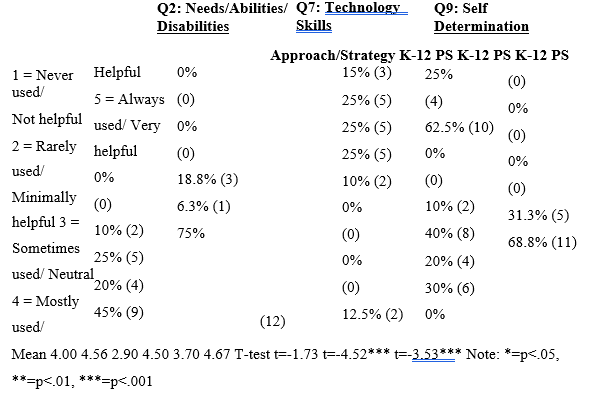
Frequencies for Predictors of Postsecondary Success by Institution Type
Q2: Needs/Abilities/ Disabilities
Q7: Technology Skills
Q9: Self
Determination
Approach/Strategy K-12 PS K-12 PS K-12 PS
1 = Never used/
Not helpful
2 = Rarely used/ Minimally helpful 3 = Sometimes used/ Neutral
4 = Mostly used/ Helpful
5 = Always used/ Very helpful
0%
(0)
10% (2)
25% (5)
20% (4)
45% (9)
0%
(0)
0%
(0)
18.8% (3)
6.3% (1)
75%
(12)
15% (3)
25% (5)
25% (5)
25% (5)
10% (2)
0%
(0)
0%
(0)
12.5% (2)
25%
(4)
62.5% (10)
0%
(0)
10% (2)
40% (8)
20% (4)
30% (6)
0%
(0)
0%
(0)
0%
(0)
31.3% (5)
68.8% (11)
Mean 4.00 4.56 2.90 4.50 3.70 4.67 T-test t=-1.73 t=-4.52*** t=-3.53*** Note: *=p<.05, **=p<.01, ***=p<.001
When asked if teaching specific or advanced technology skills (Q7) was helpful for
transition, there was no clear pattern in the responses from those in K-12, as they
were fairly evenly distributed among rarely, sometimes, and mostly using this approach,
while 62.5% the PS respondents reported that they always use this approach. The difference
in the mean responses between K-12 (2.90) and post-secondary (4.50) was significantly
different (t=-4.52, p<0.001).
Finally, when asked about teaching self-determination skills (Q9), most (40%) of the
K-12 respondents reported that they sometimes use this approach, while an overwhelming
majority (68.8%) of post-secondary respondents report that they always use this approach.
The difference in the mean responses for were again significantly different (t=-3.53,
p=0.001) with a mean of 3.70 for K-12 respondents and a mean of 4.69 for post-secondary
respondents.
These data clearly indicate that the postsecondary respondents find these three skills
critical, important with high mean scores and all responses above 2. Compared to the
K-12 mean responses, the postsecondary mean responses to the use of technology and
self-determination were statistically significantly higher. Thus, the postsecondary
respondents thought these “best practices” techniques were very important for student
transition although the K-12 respondents employed these techniques only sometimes
on average. (Please note there are mixed programs responding to these questions.)
Both sets of respondents agreed that a student’s self-awareness of their needs/abilities/disabilities
was not only important but that this strategy was actively taught.
Political Framework Analysis
For each respondent, composite scores were calculated from the Human Relations (HR)
and Bureaucratic (B) questions. Figure 1 presents a boxplot showing the mean composite
scores for the HR and B questions. A paired t-test for determining if a difference
existed between the mean composite scores for HR versus B questions yielded a p-value
of 0.318, indicating no difference in mean responses for HR questions compared to
B questions among all respondents. Basically, everyone was grouped together in this
analysis, and no factors such as institution or education position were considered.
This very broad grouping shows no difference between responses to the HR and B questions.
When all responses were examined, at all levels, respondents used both approaches
almost equally.
Even though there is no difference overall between the scores for HR versus B questions there could be differences by institution type as I hypothesized, or by educational position. Figure 2 shows boxplots of the mean composite scores for HR questions and B questions stratified by educational position. Paired t-tests were employed to test the mean difference between HR and B approaches in each group. For Field positions, the t-test statistic of 0.178 was not significant, with p=0.860, indicating there was no statistical difference between the mean scores for HR questions compared to B questions. Similarly, for Administrative positions, the t-test statistic of 1.61 was not significant (p=0.131), indicating there was no difference between mean scores for HR questions compared to B questions.
Figure 1
Boxplot of Human Resources versus Bureaucratic Frameworks
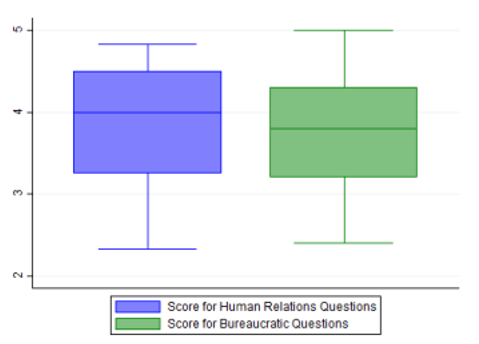
The boxplots in Figure 2 give a visual representation of how the HR and B scores are
distributed by education position and can provide some insight into the scores even
though the means are not statistically different. When reviewing a boxplot it is important
to remember that the top bar is the maximum observation with the top of the box at
the 75% percentile and the bottom at 25%. The line in the middle is the median with
the bottom bar providing the minimum observation. With this said, the plots show that
the median scores for the respondents in the Field positions were generally lower
than the median scores for respondents in the Administrative positions, both for the
HR questions and the B questions. Within the Administrative positions, the scores
for the HR questions appear to be generally higher than the scores for the B questions,
although we know they aren’t statistically different. Of interest, there is an outlier
among the HR scores that appears to fall below the B scores. Looking at the Field
positions scores, the responses to the HR questions are more spread out than the responses
to the B questions. One could surmise there is more agreement on how often the B approaches
are used than how often the HR approaches are used among those in K=12 institutions,
or more agreement on how helpful the B approaches are for transition than how helpful
the HR approaches are.
Figure 2
Boxplots of Human Resources versus Bureaucratic Frameworks by Position
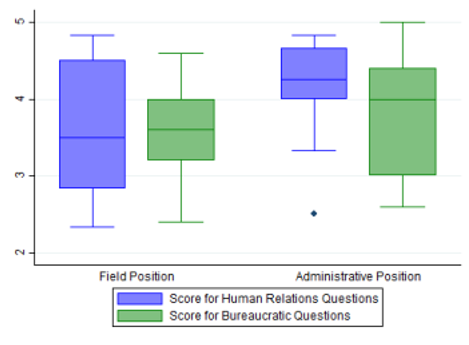
When t-tests were run on responses between the HR and B questions by institution type,
here further stratified into three levels (1=K-12, 2=community college, and 3=4-year
university) for these analyses, there were no significant differences for either K-12
or community colleges (p=0.823 for K-12, p=0.898 for community college). However,
there was a significant difference for 4-year universities indicating a preference
for an HR method rather than a B method (p=0.036). Figure 3 shows the boxplots of
the mean composite scores for HR questions and B questions stratified by institution
type. In the figure, the difference between the HR and B scores for 4-year universities
can be visualized. Since K-12 has to comply with IDEA this finding is not surprising
and actually falls in line with my hypothesis indicating that that the HR political
framework lends itself to the use of some of the documented best practices.
Figure 3
Boxplots of Human Resources versus Bureaucratic Frameworks by Institution Type
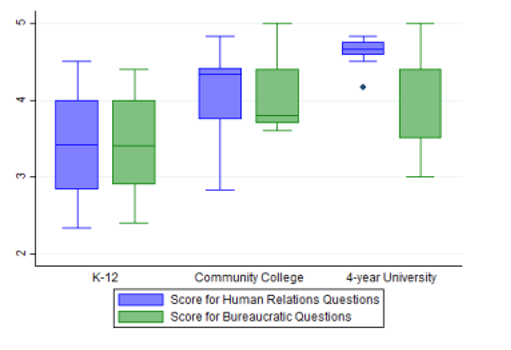
Upon examining the qualitative questions, I was able to observe an interesting phenomenon.
K-12 respondents answered in a way that indicated that they were clearly considering
legal compliance and are depending on the school district and their position in meeting
some of the laws. For postsecondary it is not the law that they must enforce, but
it is a case of encouraging support of self-determination and self-advocacy. Once
again, position refers to whether the respondent is an administrative or a field position.
Upon examination of respondents’ use of the HR or B framework, no significant difference
was found for those in the field versus those in administrative positions.
In the above analyses, the differences between the composite scores for the HR and
B were explored within each education position and within each institution type. Now,
we want to examine the differences in HR and B responses across positions and across
institution types. A one-way ANOVA of HR and B responses by the field position respondents
with the difference between HR and B responses by the administrative position respondents.
The results of the one-way ANOVA showed that there was no difference between those
in the field positions and those in administrative positions when it came to using
a HR versus a B approach (p=0.344). A one-way ANOVA of HR and B responses across institution
types was also employed to compare the difference in HR and B responses between the
K-12, community college, and 4-year universities. The results of the ANOVA indicated
there were no differences between the three types of institutions when it came to
using HR versus B (p=0.101). When a regression model including the difference in HR
and B responses with institution type was run, a significant difference appeared for
the 4-year university compared to the K-12 institutions. The difference in HR and
B responses was greater in the 4-year university respondents than the difference in
the HR and B responses in the K-12 respondents (p=0.036). This can be seen in Figure
3 where the blue boxplot of HR scores is higher than the green boxplot of B scores
for the 4-year university respondents. In contrast, there isn’t much difference between
the blue boxplot of HR scores and the green boxplot of B scores for the K-12 respondents.
Thus, our analyses by institution type show that the 4- year respondents prefer an
HR method rather than a B method, and that the preference in HR is greater than the
very slight preference (i.e. difference in mean HR and B scores) that the K-12 respondents
have for the B method.
In a two-way ANOVA it is possible to look at the association between more than two
variables. For example, we can look at the difference between HR scores and the B
scores across educational position and institution type jointly. When employing the
two way ANOVA of the difference of HR scores and B scores by education position and
institution type, there were no significant differences across institutions and positions
(p=0.169). Thus when 6 groups were formed by stratifying by educational positions
and institution type, no group preferred either the HR or B method any more than another
group as can be visualized in Figure 4.
Figure 4
Clustered Bar Chart of Means of Human Resources versus Bureaucratic Frameworks by
Position and Institution Type
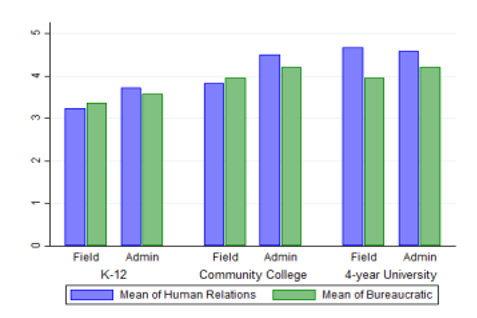
Qualitative Analysis
Analysis of Open-Ended Questions
Responses to the open-ended questions netted some surprising findings such as the
effects of the COVID-19 pandemic, the level of procedural knowledge of SPED professionals,
and the support available for SPED students. According to the respondents, the pandemic
had a deficit effect on the graduation rates of SPED students and the general student
population as presented in chapter 3. The responses also indicate that there is a
difference among SPED professionals about best practices in the field. This carried
over into the different hands-on approach of SPED professionals at community colleges
versus the hands-off approach at the higher-level institutions. Additionally, we observed
a variance in the range of student support in terms of their self-advocacy and self-determination.
In response to the question “How does your institution work with a student with an
IEP in the transition to postsecondary education?” (K12), the term “transition” was
interpreted in two different ways. For some, it was interpreted as referring to the
transition from high school into an adult day class, WorkAbility, and vocational programs.
For others, this term was used to refer to the transition to both community college
and 4-year universities. One K-12 respondent said that all students begin transitional
planning when they enter high school. In fact, the respondent said, “protocol was
set in place so students had time embedded in their classes to work on their individual
plan, including looking at some of the steps to apply for eligibility for specific
areas of employment.” Another K-12 respondent stated, “We have a system based on IDEA,
based on the transition plan, job place experience, workplace readiness and self advocacy.”
A third K-12 respondent said, “We believe in the collaboration of both the sending
and receiving teams. For example, in the Adult Transition Program (ATP) with the linkages
with the Department of Rehabilitation (DOR) ...students are running the IEP with their
goals.” These responses indicate that there is a real need for sequencing transitional
programs from the beginning to the completion of the IEP. When asked “How does your
institution work with students who had an IEP in high school as they transition to
your college/university?” (PS12), the post-secondary responses varied. Most of the
respondents discussed the campus disability center and the need for self-advocacy
and self-disclosure by the student. “Our office of disabilities, or our counselors,
assist the student in determining and explaining to faculty what accommodations they
need to provide,” explained one respondent. “All of the responsibilities fall on the
student. They must reach out to us with documentation. We immediately discuss the
differences [in parental involvement and students’ advocacy] and the role that the
parents play in this transition” another respondent explained. Overall, there was
no uniform perspective or practice among post-secondary respondents. One respondent
explained how it works at his college, “For high school seniors who transition to
our college, we go out in the fall and meet with the students to assist them in applying
for our Disabled Students Programs & Services (DSPS) intake in the spring. I help
them with registration and financial aid, and share [information about] resources
available to them. I follow up with them from their senior year in high school until
they start their first semester in college. Then, during their first semester, I help
them with their accommodations and make sure that they are communicating with their
instructors. I transfer them to one of our three groups: general caseload, WorkAbility,
or the DSPS Student Support Services (SSS) of a 4-year University.”
WorkAbility is one of the transitional programs with a focus in one question, “How
does your institution work with the WorkAbility program to prepare students for post-secondary
life?” (K13). Although the answers varied, one K-12 respondent explained, “There is
a partnership with the local WorkAbility program once the students turn 16. This program
finds temporary job placement for each student based on their transitional goal interest.”
Another K-12 respondent stated, “We really do maximize this program to expose students
to different choices. We use software to match them up with their interests and use
WorkAbility to pay students for their job and to pay staff to work with them. We wish
there were more funds in this program to reach out to more students.” One school district
has all five of their high schools connected to the WorkAbility program, while another
uses a referral process for students in the mild to moderate setting only. One K-12
respondent expressed that they were frustrated with their District’s lack of participation,
“Only one or two students participate...it could be so much more and it doesn’t feel
like we are developing it to its full potential.” One respondent explained how the
COVID-19 pandemic has really affected their participation, “This is the first year
that we are not doing an adult transition workshop for families where I bring in programs
like WorkAbility,” she said. This speaks directly to the COVID-19 impact. There was
not personal contact in valuable growth programs. Again, HR supports the student with
more personalization and goal setting.
In public administration and education, the idea of best practices is pervasive and
often guides policy and decision making. When asked, “Can you share any best practices
you use to support students who are eligible for your services as they transition
to your institution?” (PS13) responses ranged from “I don’t know” to very specific
practices. One respondent went into detail, “Preferential seating, small groups, cooperative
learning structures and all accommodations based on individual needs such as: alternative
text, additional time and shared presentation notes. There are also opportunities
to respond to incorporate as much Universal Design for Living (UDL) as possible, including
visual support and access to materials and positive reinforcement.” Other best practices
include: a team who advocates for students as they transition onto campus while connecting
to services; community outreach during high school College Night; working with the
Central Valley Regional Center (CVRC) on life skills in a dorm setting; really listening
to the needs of the students in order to make them feel included and supported; staying
in contact with the students during their transition to college, whether face-to-face
or via Zoom, so they feel connected, engaged, and they know who to talk to if they
ever need assistance. Other respondents discussed teaching the students self-advocating
as their best practices. One respondent stated, “Providing strategies and transformative
practices in advocating for themselves and knowing campus resources that apply to
them specifically”, and another discussed, “promoting the idea that the student is
driving their life and not just a passenger.” This is big indicator of the need for
the HR approach and supports my theory that students need guidance to flourish. This
in addition to implementation of the most current, evidence-based, secondary transition
predictors of postschool success: psychological empowerment, self-realization, and
technology skills (Mazzotti et al., 2020).
One of the three new predictors of post school success was self-realization (Mazzotti
et al., 2020). To determine the extent to which this was put into practice, I asked
respondents to “Please provide me with examples of how students in your district practice
or apply self-realization/self-determination as part of transition” (K14). Respondents
addresses this question with two different approaches. One K-12 respondent explained
the K-12 perspective as follows, “As part of the transition experience, we put students
in situations where they are challenged to work through the struggle to learn determination
and perseverance.” A K-12 respondent from a different district added, “In general
education, we practice how to ask for accommodations...as well as working on life
skills to ask for what they need outside of the classroom.” An interest inventory
of coursework and vocational interests was also mentioned to help students identify
areas of strength or weakness. “Those who can speak for themselves are telling us
and the Central Valley Regional Center (CVRC) workers what they want to do when they
leave us,” explained one K-12 respondent. Another said that she focuses on the parents
to make sure that they are completely aware of the self-advocacy that is required
once their child turns 18. Finally, there were two programs where they did not feel
like they had adequate training, and more work could be done to fully equip their
students to advocate for themselves in the future. This is another example of the
need for a more uniform HR approach in K-12.
When asked, “How do legal protections affect the transition process,” (PS14) responses
varied from “the laws ensuring that protocols are being followed” to “the laws making
it difficult for students to receive the accommodations that they need.” Many post-secondary
respondents discussed the differences between K-12’s IDEA and Section 504 and ADA
in postsecondary. One person stated, “Students and parents are coming in with an expectation
that we are going to repeat the K-12 experience,” while another said, “Two very distinct
legalities. K-12 IDEA versus 504 and ADA at the postsecondary level. IDEA is supported
by the IEP and very accommodating. Whereas, in college, they must meet the rigor and
may not make it...In college, the rigor is not reduced and the course outcome cannot
be legally altered...Taking care of parents is an ongoing process and a fine line.”
Most post-secondary respondents claim that the difficulty with many laws is having
to help the parents and students to understand that the parents do not have a legal
right to intervene under FERPA and HIPAA laws. In many cases, the students are used
to relying on the parents’ interventions and are unaware of how to request accommodations
on their own. Postsecondary schools are not legally allowed to assist the students
unless the students say that they need assistance.
Question K15 (“How do legal protections affect the postsecondary transition process?”)
offered a variety of responses. The K-12 focus was exemplified by one of the respondents,
“Legally we are obligated to service our students until they receive a high school
diploma, or until they turn 22. We have a legal obligation to provide them with the
widest array of options in the workforce, and to visit” ...local colleges or other
post-secondary institutions. “My entire job is affected by IDEA” explained another
K-12 respondent. Other responses discussed increased confidentiality and how parent
advocacy is greatly affected after age 18. One K-12 respondent continued, “Many parents
are unaware that when their child turns 18, or finishes high school, they no longer
legally have access to records or to make decisions for them. In parent-friendly language,
they need to understand that the parents do not have a say in their child’s life after
18 without a conservatorship or a power of attorney.” Finally, one K-12 respondent
confessed that they are “trying to determine the appropriate level of autonomy for
this difficult topic.”
In review of PS15 (“What are some barriers with this transition work?”), post - secondary
responses were very similar. Major barriers were: miscommunication between the high
schools and the postsecondary colleges in terms of documentations and information;
students needing to advocate for themselves; lack of parent understanding the FERPA
and HIPAA laws; failure to acknowledge institutional roles and the expectations between
postsecondary education and K-12; online versus face-to-face meetings; no access to
the 504 or IEP plan; and a primary lack of student and parent preparation for college
life. To quote one educator, “I think that the involvement of the parents was so much
in K-12, but it is a difficult transition for them to wean them off… The students
will, many times, go without accommodations because they assume this will happen,
and it doesn’t.”
Barriers were the topic for question K16 (“What are some barriers with the transition
to postsecondary work?”). The most frequently mentioned were: Ableism, lack of professional
training and resources; recognizing the students’ potential and meeting student, parent,
and staff expectations; conserved students who chose not to participate; a misunderstanding
by general education teachers about inclusion and the role of the SPED professional;
lack of preparation time; transportation; the balance between autonomy and independence;
and public perception that a SPED perspective student cannot do the work.
57
One K-12 respondent lamented, “Core academics, there is too much to work on. We need
a transition class for transition planning.”
When we looked at the PS16 (“Does your institution ask the student to share their
Individualized Transition Program (ITP)? Is it helpful? Why or Why not?”) many of
the postsecondary respondents claim that they don’t work with ITPs; they do not know
whether their institutions ask for students’ ITPs; they have never seen an ITP; or
they only use IEPs or 504 plans. One specific PS respondent stated, “We create transition
plans within our program, so we do not use them. We work with the student on their
transition plan and goal setting for their next step, so that it is a successful transition
to live outside of their parents’ home.” A second PS respondent said, “We do have
a program called College to Career out of the Department of Rehabilitation (DOR).
With that program, we have a counselor who works with students using the ITP, and
it is very helpful. Not every school has a DOR counselor assigned to them. We are
very fortunate.” PS16 responses demonstrate the wide and differing range of working
with SPED students.
Both questions K17 and K18 addressed the COVID-19 pandemic. With question K17 (“How
has the COVID-19 pandemic affected the special education experience at your institution?
Please include effects to that transition process.”). Answers varied dramatically,
and demonstrated success, frustration, and fear for students including: students are
gaining invaluable skills; all hands-on experiences were cancelled; teachers are struggling;
families are struggling with behavioral problems at home; normal processes are interrupted
because the family is doing the professional’s work; assessment has been a challenge;
students with disabilities are not getting what they need; and it is more difficult
for students and families to make informed decisions because they cannot tour the
program or college first-hand. One K-12 respondent put it succinctly, “It (COVID)
has affected everything….how they learn, the attendance rate has gone down as students
are not participating as they did previously, and the transition opportunities are
greatly affected. Many of our students on diploma track, who transition to Adult School
for a fifth year did not make it.” However, another K-12 respondent saw the benefit
in this experience, “The biggest shift is the virtual platforms and communication
with families and the partnership with all of the players. I was very concerned in
the beginning, but it has been wonderful.”
Mixed responses to question PS17 continued at the post-secondary level. One respondent
illustrated two opposite reactions by saying, “With online courses, it has opened
the door for some students who would have otherwise not been able to attend. On the
opposite side, some of our students have had great difficulty navigating online courses
and have not been successful because they need or want that in-person interaction
with instructors and peers.” The majority of PS17 respondents claim that the transition
to online teaching and services has been a major challenge for everyone. Teachers
had to learn to teach online; students had to make sure they had quiet places to do
their online studies; some students did not have proper access to the internet; meetings
became online resulting in healthy meetings but without needed personal contact. A
second respondent also mentioned the positive and negative aspects of the pandemic,
“There is regression, and the amount of growth has been limited since they are at
home. The positive is the students have become more technologically savvy.” All responses
fully demonstrate the contrasting feelings about the COVID-19 pandemic and education.
Question K18 (“How has the COVID-19 pandemic changed the attitudes of SPED students
considering attending college or other post-secondary education?”) continued the COVID-19
conversation. Respondents focused on the idea that students missed the in-person aspect
of school. However, students who were able to work within this virtual system thrived
with their new perspective about technology and their ability to use it in the future.
One K-12 respondent's concern was, “The social-emotional development, regardless of
their abilities, has been affected, and the support they are used to is not possible.”
Another expressed concern about the 20% drop-in graduation rates among the students
under IDEA, “As a whole system we have a lot of work to do...to help our students
catch up.” Finally, another K-12 respondent put it in perspective, “I think it has
narrowed the world view of everyone by forcing people to stay home and stay online.
With this reduced socialization things are far narrower in scope and this is not good
for the mental health and prospects for these students, under IDEA, who are homebound.”
Therefore, there are mixed and opposing points of view about the effects of the COVID
19 pandemic on SPED students within the K12 discipline.
The post-secondary responses to PS18 (“How has the COVID-19 pandemic affected the
accommodations offered to students at your institution/college?”) most often indicated
that the transition to online platforms affected the way accommodations are offered.
The focus one PS respondent stated, “Students with chronic illness are now able to
participate more than they were previously. They can also record the class.” Another
said, “The students at the college are not getting the in-person services that we
are able to provide. It has been confusing and difficult for both the students and
the instructors, but now the instructors can implement accommodations on their end
with Canvas, provided that the students self-advocate.” A third respondent said, “Those
who learn by touching have greatly been impacted. Some of these have fallen through
the cracks.” Another PS respondent said, “They have to advocate more for themselves.
They had to connect with their instructors. We had to work with a brand-new system
to provide documentation to email to the instructors. The students must follow up
on the requested accommodations. They are more involved than they were before.” Another
said, “Coaching supports have been virtual and have seen a reduction. When a student
is stuck, they are not coming to us, but, instead, they are going to their parents.
This is causing regression.” A final respondent said, “Our students are still able
to use the services, but they do not have full knowledge of the accommodations available...Having
them back in their family home really has been difficult. Utilizing technology exclusively
has been a new and exhausting experience.” In summary to this question at the post-secondary
level, there is no single line of responses. Instead, it demonstrates positives in
student learning methods versus predominant negatives in services and focus.
Finally, question K19 (“What age does your institution begin the transition process?”)
brought out a final idea from K-12 professionals. Most of the respondents said, “before
they turn 16 or at age 15.” But others had some varying responses including one that
said age three, “We start talking to them from the moment that they qualify for SPED.”
In conclusion, after a survey of forty professionals and experts from K-12, CC, 4-
year institutions, during the COVID-19 pandemic the results supported my hypothesis.
When administrators use research and evidence-based practices that are known to predict
secondary transition success for students with disabilities, they are primarily working
through the HR policy framework. If they use this humanistic model that has been shown
to promote success, the students have an improved service and are better prepared
for post-secondary success. Further, the theoretical framework being used makes a
difference in approach since the B model has been primarily utilized in the compliance
environment for special education. Finally, during the COVID-19 pandemic, special
education and the ITP have been greatly affected because of a lack of access to postsecondary
transition resources.
A transition to the HR model could take several forms including transition to CC first
with a more hands-on approach. Teaching students about the services provides in postsecondary
institutions, while they are in high school to better prepare them. Better communication,
both culturally and linguistically, to both students and parents about what to expect
once IDEA expires, and how to use these services is essential.
CHAPTER 5: DISCUSSION/SUMMARY/CONCLUSION
“Does a preferred policy framework of an administrator/teacher affect the transition
of students, with IDEA services in California, from K-12 to postsecondary education,
through the knowledge and application of researched based practices in ITPs?” Secondly,
“How have these processes been affected during the COVID-19 pandemic?” This study
found a small effect of a preferred policy framework and the quantifiable data showed
the transition processes have been affected in several specific ways due to the COVID-19
pandemic.
This study used both survey and interview responses of education professionals in
Special Education (SPED) and Disabled Students Services. The purpose was to examine
their perspectives about the role public administrators and educators’ play as special
education students K-12 transition into postsecondary (PS) education in the Central
San Joaquin Valley. The survey included both open and closed ended questions to create
a picture of approaches in preparing students for post-secondary education. Secondly,
an assessment of the administrative approach, whether bureaucratic or human resource,
was used by educators in their work. The study accounted for the type of institution
the respondent worked in, K-12, community college (CC), or 4-year university (4-year).
Also, the educational position of the respondent was considered, as to whether they
worked in the field with students or were in an administrative position, slightly
more removed from students. My research motivation was my interest in which administrative
approach the institutions use when preparing students for and aiding them during transition.
So, my dependent variable is an interest in the political framework of either the
Human Relations (HR) or Bureaucratic (B) methods.
Based on personal experience supporting my son with co-morbidities the path to his
postsecondary education was full of challenges. I hypothesized that when administrators/educators
use research and evidence-based practices that are known to predict secondary transition
success for students with disabilities if they are primarily working through the human
resources policy framework. The humanistic model has been shown to promote success
and the students, according to model supporters, have a better chance to succeed under
this model. The bureaucratic model is a more traditional and often values compliance
over quality of success of services. Finally, during the COVID 19 pandemic special
education and the Individualized Transition Plan (ITP) have been greatly affected
due to a lack of access to support services, and, most importantly, face to-face instruction
and interactions for postsecondary transition support and resources have been limited.
Discussion of Findings
As was shown in chapter 4, this study netted some surprising findings, including the
effects of the COVID-19 pandemic, the (varying) level of knowledge of professionals
in special education, and the differences in the amount support available for students
who require special education services. Respondents shared that the pandemic influenced
the graduation rates of SPED students, even the general student population. There
was a difference in knowledge among SPED professionals of the best practices in the
field, with some respondents more familiar with the evidence-based work while others
where following a more B model of compliance. This was shared in the qualitative narrative
as they self-revealed this information through the open-ended responses. There were
differences including professional development needs etc. This difference in knowledge
of policies and requirements carried over into the different hands-on approaches of
SPED professionals at community colleges versus the hands-off approach at the 4-year
institutions. A variance in the range of student support, in terms of their self-advocacy
and self-determination was found.
Respondents in both K-12 and postsecondary institutions reported that teaching students
about their needs, disabilities, and abilities is a strategy they almost always use.
In K-12, factoring parental expectations also ranked as a strategy that was frequently
employed, while students leading their own IEP meetings was among the least used.
For postsecondary respondents, teaching self-determination skills was rated very high
while the two questions related to student work experience were rated the lowest.
When examining the association of the three new predictors of postsecondary institution
success (Mazzotti et al., 2020), teaching students about their needs/disability/abilities
is where there was the greatest disparity between K-12 and postsecondary respondents.
Fewer than half (45%) of K-12 respondents report that this was a primary focus, while
75% of those in postsecondary education said they almost always do this. K-12 and
postsecondary respondents were similar in how much emphasis they put on teaching specific
or advanced technology skills and in teaching self determination skills. All three
of these new predictors are utilized in both K-12 and postsecondary, but there are
differences in the amount of emphasis and importance placed on them. These differences
could be crucial to influencing the likelihood of a successful transition into higher
education. Through these evidence-based practices students would be better equipped
and prepared for their postsecondary transition.
The administrative framework of using human resources versus bureaucratic techniques
was also examined in this study, as were responses based on the position of the respondent.
The results showed that there was no differences based on the position of the respondent
(administrator vs. in field), nor were there any significant differences between K-12
and community college practices or approaches to preparation for transition. However,
there was a significant difference for 4-year universities, indicating a preference
for a human resources-based approach rather than a bureaucratic approach. This is
an interesting finding, as those in 4-year institutions indicated they used a more
hands-off approach in practice during interviews, but then rated highly the humanistic,
human resource-based approach.
When analyzing the barriers to the transition of students from K-12 to postsecondary
there was a recurring theme of students who were unprepared to self advocate and parents
unwilling to let them go. For students who do transition to college, there appears
to be varying levels of support and ‘best practices’ within the transition. There
also appears to be a struggle to differentiate between the services offered under
IDEA and those offered under ADA and Section 504 in higher education. Students who
have relied on the support under IDEA, and parents who are used to being able to support
them, are often frustrated with the FERPA and HIPAA laws in place in colleges that
define their children as legal, autonomous adults. They indicated what students and
parents alike don’t understand is, as soon as the students transition to college,
it becomes a legal issue for the colleges to reveal any information to the parents
without a student consent form. Consequently, if students remain silent and do not
ask for accommodations, the parents cannot legally become involved without proper
consent from the student. Survey respondents reported that this happens with new students
trying to avoid services or self-disclosure, often until they do not complete their
education because they have lost their path.
The community college respondents consistently noted outreach as a main component
when discussing support services in the transition from high school. Many of their
programs follow the students from the 12th grade through their second year in college.
Although community colleges are under ADA requirements, these services were established
through the community colleges’ value system and their strong relationships with feeder
districts. The students’ success is their focus.
Additionally, the COVID-19 pandemic has created an environment where students are
expected to advocate for themselves. There is no on-campus support or professional
one-on-one help. A majority of those interviewed stated that the COVID-19 pandemic
negatively affected students who receive special education services systemically,
as there were no in-person services and no in-person instruction. Community-based
learning, Workability, and other adult education programs essentially ceased to function
during this time. It was also more difficult for the instructors because students
lacked access, would shut down or did not participate, thereby losing important instruction
and services, often leaving them relying exclusively on family support. However, some
students were able to gain an online distance learning experience by using the resources
they had at home to learn remotely. One possible benefit of the distance learning
was that this new remote learning also gave parents a firsthand look at the challenges
in educating their students both in and out of the classroom. The COVID 19 pandemic
essentially taught special education students to be more independent learners, which
was not universally successful. In general, the positive comments about the pandemic
were mostly about small, niche populations, though the K-12 respondents primarily
indicated there would be negative and long-lasting effects for students who receive
special education services.
Data collected for this study indicate there is a significant preference for the human
resources administrative framework by 4-year institutions, compared to both K-12 and
community colleges. The data also indicate that when comparing the responses that
are in line with the three new predictors of postsecondary success for students utilizing
IDEA (psychological empowerment, self-realization and technology skills) those from
K-12 and those from postsecondary institutions. As stated in Chapter 4, those in K-12
primarily focus on the student’s needs while postsecondary institutions only respond
when students express a need. In all, the results continued to show that postsecondary
institutions preferred a human resources-based approach in the preparation of K-12
students for their postsecondary experience.
Limitations
The limitations for this study included geographic boundaries, the format of the survey,
and the existence of a COVID-19 pandemic. The study was focused on and limited to
the Central San Joaquin Valley, specifically Fresno and Merced Counties, and thus
it only includes perspectives from special education instructors and administrators
from one region of California. Using a survey to capture activities and perceived
important and impact could possibly obscure some of the story by limiting possible
responses. In some cases, the questions presented made it difficult to compare the
answers of the respondents in K-12 to the postsecondary respondents as K-12 answered
about their use of specific approaches while postsecondary respondents answered about
what they thought would be the best approach or priority. There was also one additional
question that was not included in the postsecondary questions, creating no means of
comparison. After collecting the data, I found there may be some measurement error
due to the use of the term “transition” since it was interpreted in different ways
depending on the program the administrator or educator worked in. Future studies should
ensure that all interviewees /sample are teaching/working with students who are graduating
with a diploma and transitioning to college. This would reduce the varying definition
used for the word transition. Finally, the COVID-19 pandemic occurred in the middle
of the study and influenced the interview and question format. Meetings were conducted
via Zoom to assure social distancing and some questions were moved to a survey, rather
than gathered through classroom observations or during interviews, as originally planned.
Recommendations and Suggestions for Future Research
There are several important initial findings presented here, but this research could
be expanded and enhanced with a survey of the students utilizing IDEA in the Central
San Joaquin Valley, as they transitioned from K-12 to postsecondary during the COVID
19 pandemic. The research could also be replicated once the pandemic is over. Emphasis
should be on the years between 2020 and 2022. The responses from the second survey
could be compared to the responses from this survey to gather insight toward improving,
modifying, or confirming current best practices utilizing both the human resources
and bureaucratic frameworks.
A study with an equal sample of K-12 students who have been instructed on self determination
and have led their IEP meetings versus a sample who students who did not self- advocate
or receive special guidance. The study could follow the students through the transition
and into their college experience, observing how they handled their self disclosure,
capturing their use of services and requests for accommodations, and tracking their
success in earning college credits.
When the Supreme Court passed the landmark case, Endrew F. v. Douglas County School
District Re-1 (2017), questioning what constitutes “educational benefit” by school
districts in order to provide Free Appropriate Public Education (FAPE), it changed
the trajectory for many students with differing abilities. After that ruling, students
had the legal right to be supported in K-12 to a progressive level, given their own
unique situation, with the right to determine their own future. This study attempted
to add to the benefit knowledge; more is needed.
REFERENCES
The Americans with Disabilities Act National Network. (n.d.) What are a public or
private college-university's responsibilities to students with disabilities? https://adata.org/faq/what-are-public-or-private-college-universitys-responsibilities
students-disabilities
Bui, C. (2019, October 14). About Fresno Unified. Fresno Unified School District.
https://www.fresnounified.org/about/
Burke, K. M., Shogren, K. A., Antosh, A. A., Raley, S. K., LaPlante, T., & Wehmeyer,
M. L. (2019). Implementing evidence-based practices to promote self determination:
Lessons learned from a state-wide implementation of the self determined learning model
of instruction. Education and Training in Autism and Developmental Disabilities, 54(1),
18-29. https://files.eric.ed.gov/fulltext/EJ1205709.pdf
Caillier, J. (2010). Factors affecting job performance in public agencies. Public
Performance & Management Review, 34(2), 139-165. http://www.jstor.org/stable/41104055
California Department of Education. (n.d.-a) California special education local plan areas. https://www.cde.ca.gov/sp/se/as/caselpas.asp
California Department of Education. (n.d.-b). Special education local plan area: Local
plan.
California Department of Education. (n.d.-c) Workability I: A California transition
program.
California Department of Education. (2020). Core Components-Rtl2.
CDE/EdSource/FCMAT. (n.d.-a). Clovis Unified District Summary. Ed-Data: Education
Data Partnership. http://www.ed-data.org/district/Fresno/Clovis-Unified
CDE/EdSource/FCMAT. (n.d.-b). Fresno County Summary. Ed-Data: Education Data Partnership.
http://www.ed-data.org/county/Fresno
CDE/EdSource/FCMAT. (n.d.-c). Fresno Unified District Summary. Ed-Data: Education
Data Partnership. http://www.ed-data.org/district/Fresno/Fresno-Unified
Charmatz, M. (2020). Postsecondary education, COVID-19, and students with disabilities.
Disability Compliance for Higher Education, 26(2), 1-3. https://doi.org/10.1002/dhe.30899